Turkish YouTube Videos as a Source of Information on Biologic Therapies in Rheumatic Diseases: An Assessment of Quality, Reliability, and Content
Quality of YouTube Videos on Biologic Therapies
Authors
-
Nihal Lermi
Department of Rheumatology, University of Health Sciences, Istanbul Kartal Dr. Lütfi Kırdar Health Research Center, Istanbul, Türkiye
 https://orcid.org/0000-0002-2774-5913
-
Zeynep Fural
Department of Rheumatology, University of Health Sciences, Istanbul Kartal Dr. Lütfi Kırdar Health Research Center, Istanbul, Türkiye
https://orcid.org/0000-0001-5859-2502

Keywords:
biologic therapy, patient education, rheumatic diseases, reliability, YouTubeAbstract
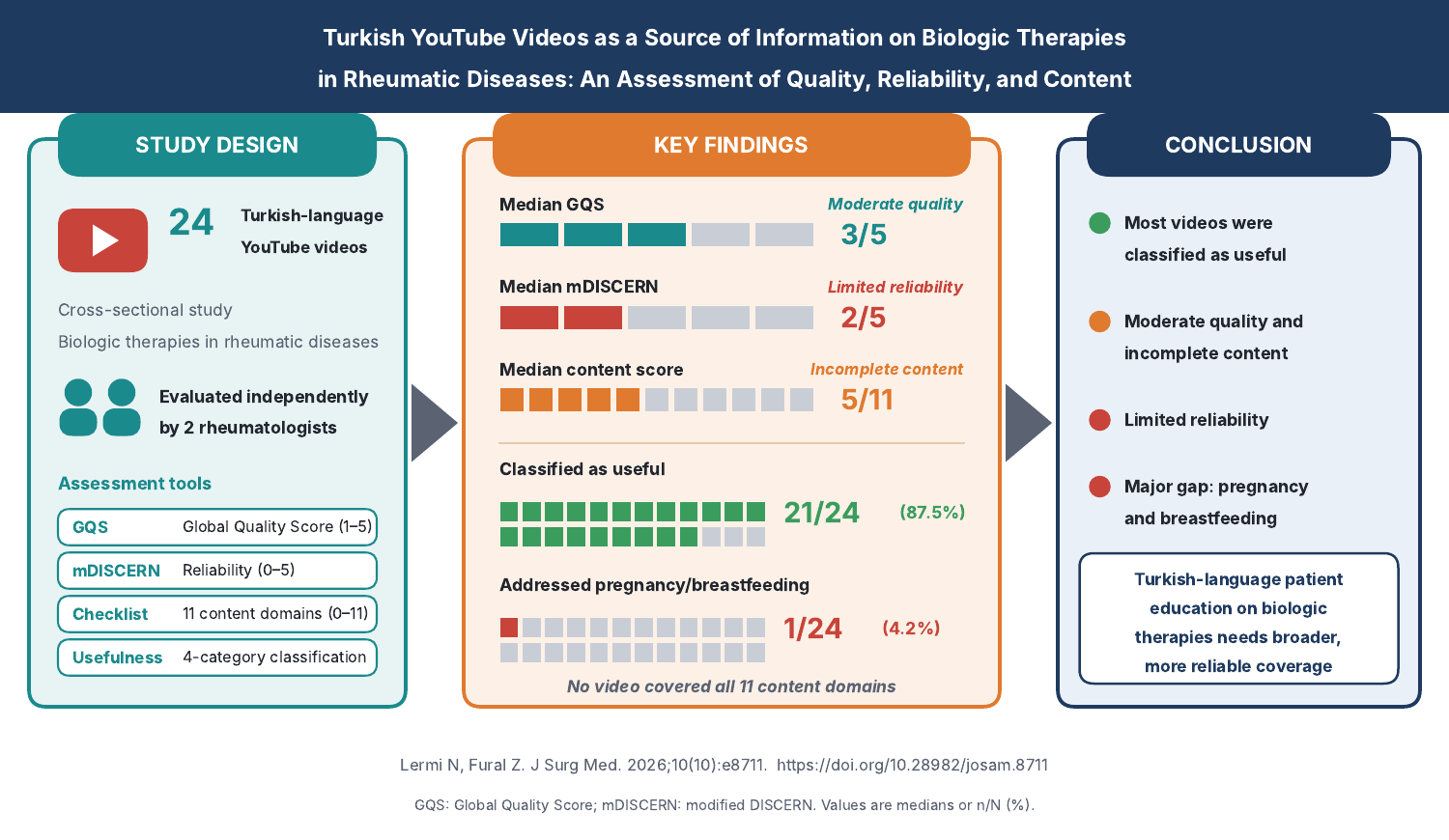
Background/Aim: YouTube is increasingly used as a source of health-related information; however, the quality and reliability of Turkish-language content on biologic therapies in rheumatic diseases remain unclear. This study aimed to evaluate the quality, reliability, usefulness, and content completeness of Turkish-language YouTube videos on biologic therapies.
Methods: In this cross-sectional study, 24 eligible videos were independently evaluated by two rheumatologists using the modified DISCERN (mDISCERN), Global Quality Score (GQS), usefulness classification, and an 11-item content checklist.
Results: Twenty videos (83.3%) were physician-presented. The median content score was 5 (range, 1–10), and no video addressed all 11 domains. Indications for biologic therapy were the most frequently covered domain (79.2%), whereas pregnancy/breastfeeding was the least frequently addressed (4.2%). The median mDISCERN and GQS scores were 2 (range, 1–4) and 3 (range, 1–5), respectively, and 21 videos (87.5%) were classified as useful. GQS correlated with mDISCERN (ρ = 0.452, P = 0.026) and content score (ρ = 0.436, P = 0.033). Video duration correlated strongly with content score (ρ = 0.801, P < 0.001) and moderately with GQS (ρ = 0.474, P = 0.019), whereas views and likes were not associated with quality, reliability, or content completeness.
Conclusion: Turkish-language YouTube videos on biologic therapies were generally useful but showed limited reliability and incomplete content. The marked lack of information on pregnancy and breastfeeding highlights an important gap in patient-oriented educational content.
Downloads
References
Kocyigit BF, Akyol A. YouTube as a source of information on COVID-19 vaccination in rheumatic diseases. Rheumatol Int. 2021;41(12):2109-15. https://doi.org/10.1007/s00296-021-05010-2.
Zengin O, Onder ME. Educational quality of YouTube videos on musculoskeletal ultrasound. Clin Rheumatol. 2021;40(10):4243-51. https://doi.org/10.1007/s10067-021-05793-6.
Zengin O, Onder ME. YouTube for information about side effects of biologic therapy: a social media analysis. Int J Rheum Dis. 2020;23(12):1645-50. https://doi.org/10.1111/1756-185X.14003.
Yagiz B, Coskun BN, Yunus Halil E, Dalkilic E, Pehlivan Y. The efficacy and reliability of English YouTube videos as a source of information for pregnant rheumatoid arthritis patients. Clin Rheumatol. 2023;42(12):3311-20. https://doi.org/10.1007/s10067-023-06780-9.
Kocyigit BF, Akaltun MS. Does YouTube provide high quality information? Assessment of secukinumab videos. Rheumatol Int. 2019;39(7):1263-8. https://doi.org/10.1007/s00296-019-04322-8.
Koçak Ulucaköy R, Kayacan Erdoğan E. A review of YouTube videos in the Turkish language about ankylosing spondylitis. Turkiye Klinikleri J Phys Med Rehabil Sci. 2025;28(1):63-9. https://doi.org/10.31609/jpmrs.2024-106018.
Drozd B, Couvillon E, Suarez A. Medical YouTube videos and methods of evaluation: literature review. JMIR Med Educ. 2018;4(1):e3. https://doi.org/10.2196/mededu.8527.
Madathil KC, Rivera-Rodriguez AJ, Greenstein JS, Gramopadhye AK. Healthcare information on YouTube: a systematic review. Health Informatics J. 2015;21(3):173-94. https://doi.org/10.1177/1460458213512220.
Pamukcu M, Izci Duran T. Are YouTube videos enough to learn anakinra self-injection? Rheumatol Int. 2021;41(12):2125-31. https://doi.org/10.1007/s00296-021-04999-w.
Tolu S, Yurdakul OV, Basaran B, Rezvani A. English-language videos on YouTube as a source of information on self-administer subcutaneous anti-tumour necrosis factor agent injections. Rheumatol Int. 2018;38(7):1285-92. https://doi.org/10.1007/s00296-018-4047-8.
Elangovan S, Kwan YH, Fong W. The usefulness and validity of English-language videos on YouTube as an educational resource for spondyloarthritis. Clin Rheumatol. 2021;40(4):1567-73. https://doi.org/10.1007/s10067-020-05377-w.
Ng CH, Lim GRS, Fong W. Quality of English-language videos on YouTube as a source of information on systemic lupus erythematosus. Int J Rheum Dis. 2020;23(12):1636-44. https://doi.org/10.1111/1756-185X.13852.
Delli K, Livas C, Vissink A, Spijkervet FKL. Is YouTube useful as a source of information for Sjögren's syndrome? Oral Dis. 2016;22(3):196-201. https://doi.org/10.1111/odi.12404.
Bernard A, Langille M, Hughes S, Rose C, Leddin D, Veldhuyzen van Zanten S. A systematic review of patient inflammatory bowel disease information resources on the World Wide Web. Am J Gastroenterol. 2007;102(9):2070-7. https://doi.org/10.1111/j.1572-0241.2007.01325.x.
Charnock D, Shepperd S, Needham G, Gann R. DISCERN: an instrument for judging the quality of written consumer health information on treatment choices. J Epidemiol Community Health. 1999;53(2):105-11. https://doi.org/10.1136/jech.53.2.105.
Coşkun BN, Yagiz B, Giounous Chalil E, Dalkılıç E, Pehlivan Y. The usefulness and reliability of English-language YouTube videos as a source of knowledge for patients with familial Mediterranean fever. PeerJ. 2024;12:e16857. https://doi.org/10.7717/peerj.16857.
Seyyar M, Sahin E. Türkçe YouTube videolarında immünoterapi: kalite, güvenirlik ve bilgi içeriğinin değerlendirilmesi. Acta Med Nicomedia. 2026;9:1-7. https://doi.org/10.53446/actamednicomedia.1850758.
Yerlanova D, Zimba O, Khojakulova U, Yessirkepov M, Kocyigit BF. Analysis of YouTube videos on rheumatic diseases and pregnancy: a cross-sectional study. Rheumatol Int. 2026;46:68. https://doi.org/10.1007/s00296-026-06102-7.
Rüegg L, Pluma A, Hamroun S, Cecchi I, Perez-Garcia LF, Anderson PO, et al. EULAR recommendations for use of antirheumatic drugs in reproduction, pregnancy, and lactation: 2024 update. Ann Rheum Dis. 2025;84(6):910-26. https://doi.org/10.1016/j.ard.2025.02.023.
Sammaritano LR, Bermas BL, Chakravarty EE, Chambers C, Clowse MEB, Lockshin MD, et al. 2020 American College of Rheumatology guideline for the management of reproductive health in rheumatic and musculoskeletal diseases. Arthritis Care Res (Hoboken). 2020;72(4):461-88. https://doi.org/10.1002/acr.24130.
Downloads
- 44 30
Published
Issue
Section
How to Cite
License
Copyright (c) 2026 Nihal Lermi, Zeynep Fural

This work is licensed under a Creative Commons Attribution-NonCommercial-NoDerivatives 4.0 International License.
Citations