Comparative effectiveness of prolotherapy and platelet-rich plasma in patients with stage II–III gonarthrosis: A randomized controlled trial
Prolotherapy and platelet-rich plasma in patients with gonarthrosis
Authors
-
Fatih Güzel
Department of Orthopedics and Traumatology, Başakşehir Çam and Sakura City Hospital, Istanbul, Turkey
 https://orcid.org/0000-0002-2622-8199
-
Cihan Adanaş
Department of Orthopedics and Traumatology, Van Yüzüncü Yıl University Faculty of Medicine, Van, Türkiye
https://orcid.org/0000-0002-3652-6077
-
Sezai Özkan
Department of Orthopedics and Traumatology, Van Yüzüncü Yıl University Faculty of Medicine, Van, Türkiye
https://orcid.org/0000-0003-4444-6939

Keywords:
gonarthrosis, knee osteoarthritis, platelet-rich plasma, prolotherapy, randomized controlled trialAbstract
Background/Aim: Gonarthrosis (knee osteoarthritis) is a common degenerative musculoskeletal condition that causes progressive joint pain, stiffness, and functional impairment. Conservative nonsurgical treatments primarily provide symptomatic relief, whereas regenerative orthobiologic interventions, including platelet-rich plasma (PRP) and hyperosmolar dextrose prolotherapy, have attracted interest because of their potential therapeutic effects. This study compared the clinical effectiveness of PRP and dextrose prolotherapy in patients with stage II–III gonarthrosis.
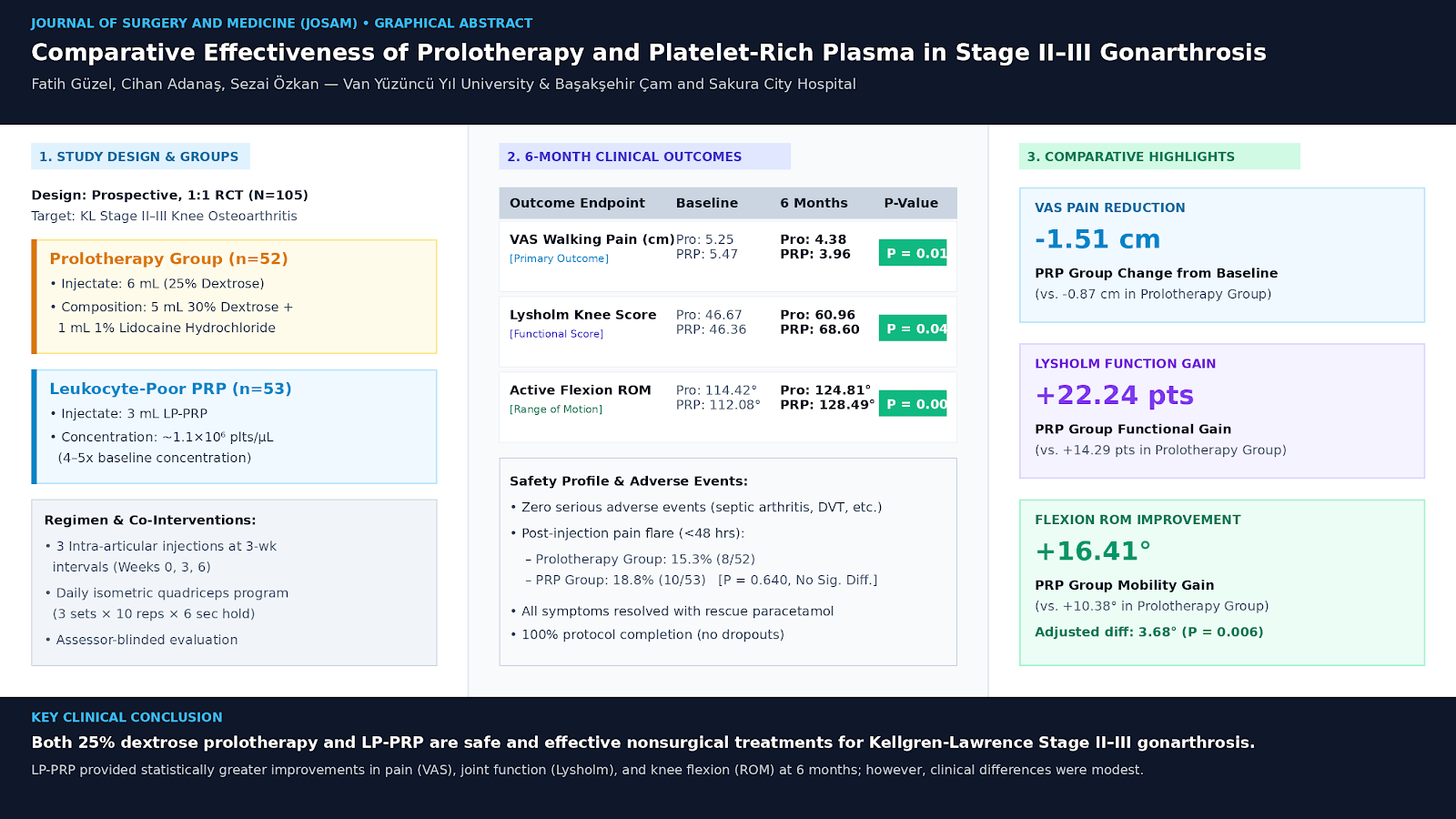
Methods: In this prospective, randomized, assessor-blinded controlled trial, 105 patients aged 40–70 years with Kellgren–Lawrence grade II–III gonarthrosis were enrolled between November 2020 and April 2021 and followed through October 2021. Participants received three intra-articular injections of either 25% dextrose prolotherapy (n = 52; 6 mL) or leukocyte-poor PRP (n = 53; 3 mL; estimated 4- to 5-fold baseline platelet concentration) at 3-week intervals. Both groups performed a standardized daily quadriceps-strengthening program. The prespecified primary outcome was the Visual Analog Scale (VAS) walking-pain score at 6 months. Secondary outcomes were the Lysholm Knee Score and active knee-flexion range of motion (ROM), assessed at baseline and at 3 and 6 months. Data were analyzed using linear mixed-effects models with 95% confidence intervals (CIs) and exact P-values.
Results: All 105 randomized participants completed the protocol. Both groups showed significant improvements in pain and function from baseline to 6 months (P < 0.001). At 6 months, PRP produced greater improvement than prolotherapy in the VAS pain score (adjusted mean difference, 0.42 cm; 95% CI, 0.08–0.76; P = 0.015; group-by-time interaction, P = 0.018), Lysholm score (adjusted mean difference, 7.64 points; 95% CI, 0.32–14.96; P = 0.041; interaction, P = 0.024), and knee-flexion ROM (adjusted mean difference, 3.68°; 95% CI, 0.51–6.85; P = 0.006). No serious adverse events occurred. Transient postinjection soreness occurred in 15.3% of prolotherapy recipients and 18.8% of PRP recipients (P = 0.640).
Conclusion: Both leukocyte-poor PRP and 25% dextrose prolotherapy were safe and effective nonsurgical treatments for early- to moderate-stage knee osteoarthritis. PRP provided statistically greater improvements in pain, function, and mobility at 6 months; however, the between-group differences were modest and should be interpreted in relation to clinically important thresholds.
Downloads
References
Charlesworth J, Fitzpatrick J, Perera NKP, Orchard J. Osteoarthritis: a systematic review of long-term safety implications for osteoarthritis of the knee. BMC Musculoskelet Disord. 2019;20(1):151. doi: 10.1186/s12891-019-2525-0.
Felson DT. Epidemiology of hip and knee osteoarthritis. Epidemiol Rev. 1988;10:1-28. doi: 10.1093/oxfordjournals.epirev.a036017.
Dennison E, Cooper C. Osteoarthritis: epidemiology and classification. In: Hochberg MC, Silman AJ, Smolen JS, Weinblatt ME, Weisman MH, editors. Rheumatology. 3rd ed. London: Mosby; 2003. p. 1781-92.
Eroğlu A, Sarı A, Durmuş B. Platelet-rich plasma vs prolotherapy in the management of knee osteoarthritis: randomized placebo-controlled trial. Turk J Sports Med. 2016;51(2):34-43. doi: 10.5152/tjsm.2016.005.
DeChellis DM, Cortazzo MH. Regenerative medicine in the field of pain medicine: prolotherapy, platelet-rich plasma therapy, and stem cell therapy-theory and evidence. Tech Reg Anesth Pain Manag. 2011;15(2):74-80. doi: 10.1053/j.trap.2011.05.002.
Dhillon RS, Schwarz EM, Maloney MD. Platelet-rich plasma therapy-future or trend? Arthritis Res Ther. 2012;14(4):219. doi: 10.1186/ar3914.
Weibrich G, Kleis WKG, Hafner G. Growth factor levels in the platelet-rich plasma produced by 2 different methods: Curasan-type PRP kit versus PCCS PRP system. Int J Oral Maxillofac Implants. 2002;17(2):184-90.
Distel LM, Best TM. Prolotherapy: a clinical review of its role in treating chronic musculoskeletal pain. PM R. 2011;3(6 Suppl 1):S78-81. doi: 10.1016/j.pmrj.2011.04.003.
Özcan E, Toska Sert A. Kas iskelet ağrısı tedavisinde proloterapinin kanıta dayalı kullanımı. Turk J Phys Med Rehab. 2016;62(2):192-8. doi: 10.5606/tftrd.2016.71770.
Meheux CJ, McCulloch PC, Lintner DM, Varner KE, Harris JD. Efficacy of intra-articular platelet-rich plasma injections in knee osteoarthritis: a systematic review. Arthroscopy. 2016;32(3):495-505. doi: 10.1016/j.arthro.2015.08.005.
Rodriguez-Merchan EC. Intraarticular injections of platelet-rich plasma in the management of knee osteoarthritis. Arch Bone Jt Surg. 2013;1(1):5-8.
Eslamian F, Amouzandeh B. Therapeutic effects of prolotherapy with intra-articular dextrose injection in patients with moderate knee osteoarthritis: a single-arm study with 6 months follow-up. Ther Adv Musculoskelet Disord. 2015;7(2):35-44. doi: 10.1177/1759720X14566618.
Laudy AB, Bakker EW, Rekers M, Moen MH. Efficacy of platelet-rich plasma injections in osteoarthritis of the knee: a systematic review and meta-analysis. Br J Sports Med. 2015;49(10):657-62. doi: 10.1136/bjsports-2014-094036.
Rabago D, Patterson JJ, Mundt M, Kijowski R, Grettie J, Segal NA, et al. Dextrose prolotherapy for knee osteoarthritis: a randomized controlled trial. Ann Fam Med. 2013;11(3):229-37. doi: 10.1370/afm.1504.
Reeves KD, Hassanein K. Randomized prospective double-blind placebo-controlled study of dextrose prolotherapy for knee osteoarthritis with or without ACL laxity. Altern Ther Health Med. 2000;6(2):68-74, 77-80.
Briggs KK, Lysholm J, Tegner Y, Rodkey WG, Kocher MS, Steadman JR. The reliability, validity, and responsiveness of the Lysholm score and Tegner activity scale for anterior cruciate ligament injuries of the knee: 25 years later. Am J Sports Med. 2009;37(5):890-7. doi: 10.1177/0363546508330143.
Tubach F, Ravaud P, Baron G, Falissard B, Logeart I, Bellamy N, et al. Evaluation of clinically relevant changes in patient-reported outcomes in knee and hip osteoarthritis: the minimal clinically important improvement. Ann Rheum Dis. 2005;64(1):29-33. doi: 10.1136/ard.2004.022905.
Celik D, Coşkunsu D, Kılıçoğlu Ö. Translation and cultural adaptation of the Turkish Lysholm Knee Scale: ease of use, validity, and reliability. Clin Orthop Relat Res. 2013;471(8):2602-10. doi: 10.1007/s11999-013-3046-z.
Downloads
- 292 383
Published
Issue
Section
How to Cite
License
Copyright (c) 2026 Fatih Güzel, Cihan Adanaş, Sezai Özkan

This work is licensed under a Creative Commons Attribution-NonCommercial-NoDerivatives 4.0 International License.
Citations