The effect of preoperative anxiety levels on intraoperative hemodynamics and postoperative pain in rhinoplasty surgery
Anxiety and perioperative outcomes in rhinoplasty
Authors
-
Salih İnce
Department of Anesthesiology and Reanimation, İdil State Hospital, şıRnak, Türkiye
 https://orcid.org/0009-0000-7131-7513
-
Gülçin Büyükbezirci
Department of Anesthesiology and Reanimation, Faculty of Medicine, Necmettin Erbakan University, Konya, Türkiye
https://orcid.org/0000-0002-9438-3414
-
Atilla Erol
Department of Anesthesiology and Reanimation, Faculty of Medicine, Necmettin Erbakan University, Konya, Türkiye
https://orcid.org/0000-0002-2376-2759
-
Ahmet Koyuncu
Department of Plastic, Reconstructive and Aesthetic Surgery, Faculty of Medicine, Necmettin Erbakan University, Konya, Türkiye
https://orcid.org/0009-0004-8878-8660
-
Ruhiye Reisli
Department of Anesthesiology and Reanimation, Faculty of Medicine, Necmettin Erbakan University, Konya, Türkiye
https://orcid.org/0000-0002-1616-5497

Keywords:
Analgesia, anxiety, rhinoplastyAbstract
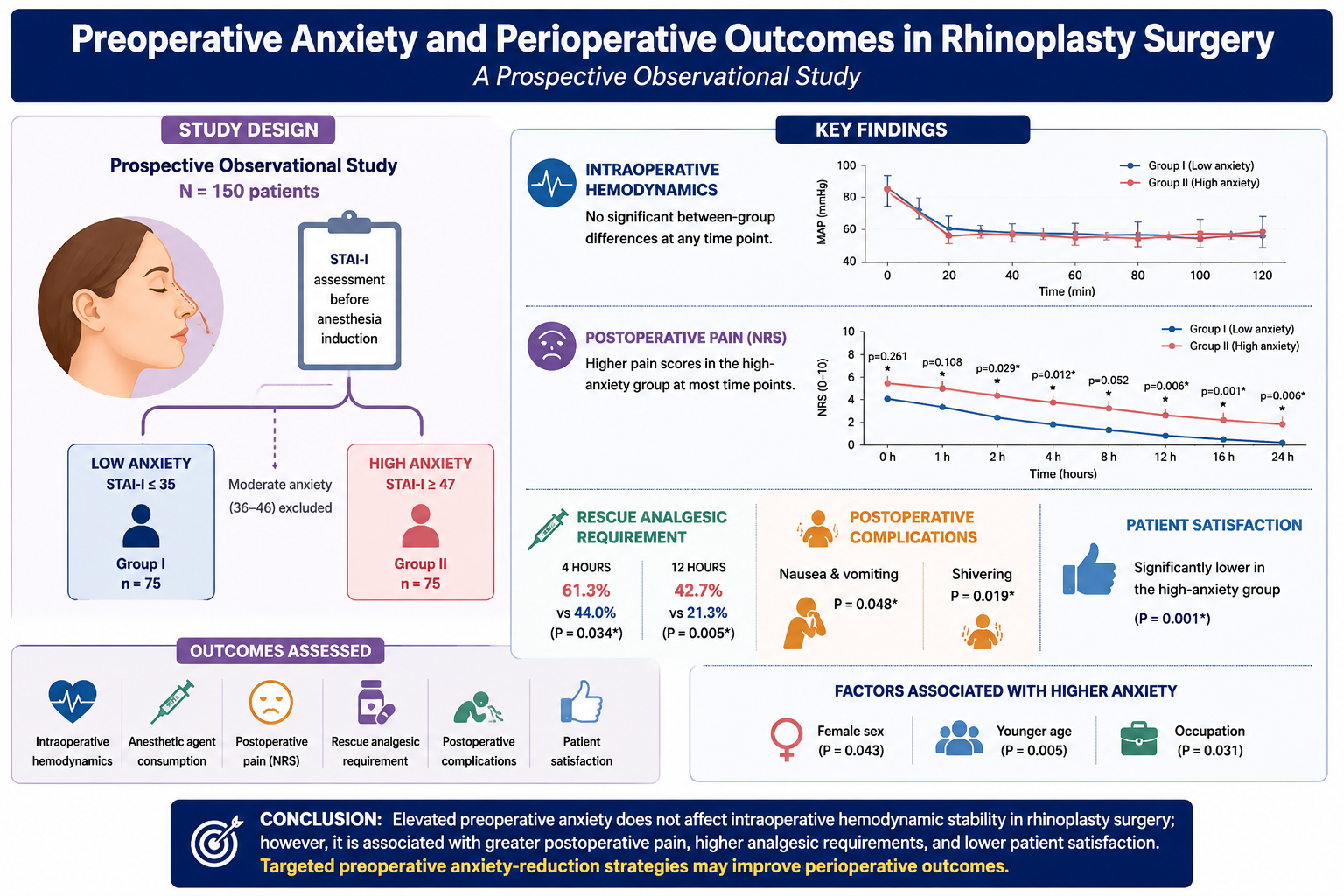
Background/Aim: Preoperative anxiety is common among surgical patients and may adversely affect perioperative outcomes; however, its influence in patients undergoing rhinoplasty remains insufficiently characterized. This study aimed to investigate the impact of preoperative anxiety levels on intraoperative hemodynamic parameters, postoperative pain intensity, analgesic consumption, postoperative complications, and patient satisfaction in patients undergoing rhinoplasty.
Methods: This single-center, prospective observational study included 150 patients aged 18–60 years with American Society of Anesthesiologists (ASA) physical status I–II who underwent rhinoplasty. Preoperative anxiety was assessed using the State-Trait Anxiety Inventory-State (STAI-I), and patients were stratified into low- and high-anxiety groups. Intraoperative hemodynamic parameters, anesthetic agent consumption, postoperative pain scores, rescue analgesic requirements, postoperative complications, and patient satisfaction were compared between groups.
Results: No significant between-group differences were observed in intraoperative hemodynamic parameters or intraoperative adverse events. Patients in the high-anxiety group had higher postoperative pain scores at most assessed time points and more frequently required rescue analgesia at 4 hours (61.3% vs 44.0%; P = 0.034) and 12 hours (42.7% vs 21.3%; P = 0.005). Postoperative nausea and vomiting (P = 0.048) and shivering (P = 0.019) were more frequent in the high-anxiety group, and patient satisfaction was lower (P = 0.001). Female sex (P = 0.043), younger age (P = 0.005), and occupation (P = 0.031) were significantly associated with anxiety group.
Conclusion: Elevated preoperative anxiety does not appear to influence intraoperative hemodynamic stability in patients undergoing rhinoplasty; however, it is associated with greater postoperative pain, higher rescue analgesic requirements, and lower patient satisfaction. These findings support the clinical value of targeted preoperative anxiety-reduction strategies to optimize perioperative outcomes.
Downloads
References
Caumo W, Schmidt AP, Schneider CN, Bergmann J, Iwamoto CW, Adamatti LC, et al. Risk factors for postoperative anxiety in adults. Anaesthesia. 2001;56(8):720-8. doi: 10.1046/j.1365-2044.2001.01842.x. DOI: https://doi.org/10.1046/j.1365-2044.2001.01842.x
Kim WS, Byeon GJ, Song BJ, Lee HJ. Availability of preoperative anxiety scale as a predictive factor for hemodynamic changes during induction of anesthesia. Korean J Anesthesiol. 2010;58(4):328-33. doi: 10.4097/kjae.2010.58.4.328. DOI: https://doi.org/10.4097/kjae.2010.58.4.328
Nigussie S, Belachew T, Wolancho W. Predictors of preoperative anxiety among surgical patients in Jimma University Specialized Teaching Hospital, South Western Ethiopia. BMC Surg. 2014;14:67. doi: 10.1186/1471-2482-14-67. DOI: https://doi.org/10.1186/1471-2482-14-67
Qaddumi J, Arda AM, Alkhawaldeh A, ALBashtawy M, Abdalrahim A, ALBashtawy S, et al. Preoperative anxiety, postoperative pain tolerance and analgesia consumption: a prospective cohort study. J Perioper Pract. 2025;35(10):426-36. doi: 10.1177/17504589241253489. DOI: https://doi.org/10.1177/17504589241253489
Oh J, Lee W, Ki S, Suh J, Hwang S, Lee J. Assessment of preoperative anxiety and influencing factors in patients undergoing elective surgery: an observational cross-sectional study. Medicina (Kaunas). 2024;60(3):403. doi: 10.3390/medicina60030403. DOI: https://doi.org/10.3390/medicina60030403
Şahin C, İmer Aras H. Influence of nasal pack removal on patients' anxiety after septoplasty. Kulak Burun Bogaz Ihtis Derg. 2015;25(5):266-70. doi: 10.5606/kbbihtisas.2015.93609. DOI: https://doi.org/10.5606/kbbihtisas.2015.93609
Çelik MR, Güneş HY. The effects of detailed preoperative information on postoperative pain and anxiety levels in rhinoplasty surgery. East J Med. 2023;28(3):471-6. doi: 10.5505/ejm.2023.34022. DOI: https://doi.org/10.5505/ejm.2023.34022
Aloweidi A, Abu-Halaweh S, Almustafa M, Marei Z, Yaghi S, Hababeh L, et al. Preoperative anxiety among adult patients undergoing elective surgeries at a tertiary teaching hospital: a cross-sectional study during the era of COVID-19 vaccination. Healthcare (Basel). 2022;10(3):515. doi: 10.3390/healthcare10030515. DOI: https://doi.org/10.3390/healthcare10030515
Erkilic E, Kesimci E, Soykut C, Doger C, Gumus T, Kanbak O. Factors associated with preoperative anxiety levels of Turkish surgical patients: from a single center in Ankara. Patient Prefer Adherence. 2017;11:291-6. doi: 10.2147/PPA.S127342. DOI: https://doi.org/10.2147/PPA.S127342
Bedaso A, Mekonnen N, Duko B. Prevalence and factors associated with preoperative anxiety among patients undergoing surgery in low-income and middle-income countries: a systematic review and meta-analysis. BMJ Open. 2022;12(3):e058187. doi: 10.1136/bmjopen-2021-058187. DOI: https://doi.org/10.1136/bmjopen-2021-058187
Topal Hançer A, Erturhan Türk K. Determination of Preoperative Anxiety Levels and Affecting Factors in Patients Undergoing Elective Surgery: A Descriptive and Cross-Sectional Study. Turkiye Klinikleri J Nurs Sci. 2024;16(1):35-42. doi: 10.5336/nurses.2023-100081. DOI: https://doi.org/10.5336/nurses.2023-100081
Ahmetovic-Djug J, Hasukic S, Djug H, Hasukic B, Jahic A. Impact of preoperative anxiety in patients on hemodynamic changes and a dose of anesthetic during induction of anesthesia. Med Arch. 2017;71(5):330-3. doi: 10.5455/medarh.2017.71.330-333. DOI: https://doi.org/10.5455/medarh.2017.71.330-333
Bayrak A, Sagiroglu G, Copuroglu E. Effects of preoperative anxiety on intraoperative hemodynamics and postoperative pain. J Coll Physicians Surg Pak. 2019;29(9):868-73. doi: 10.29271/jcpsp.2019.09.868. DOI: https://doi.org/10.29271/jcpsp.2019.09.868
Chen YYK, Soens MA, Kovacheva VP. Less stress, better success: a scoping review on the effects of anxiety on anesthetic and analgesic consumption. J Anesth. 2022;36(4):532-53. doi: 10.1007/s00540-022-03081-4. DOI: https://doi.org/10.1007/s00540-022-03081-4
Downloads
- 139 107
Published
Issue
Section
How to Cite
License
Copyright (c) 2026 Salih İnce, Gülçin Büyükbezirci, Atilla Erol, Ahmet Koyuncu, Ruhiye Reisli

This work is licensed under a Creative Commons Attribution-NonCommercial-NoDerivatives 4.0 International License.
Citations