The Use of 5-Aminolevulinic Acid in Glioma Surgery: From Intracranial to Spinal Applications
A Narrative Review of Intracranial and Spinal Applications
Authors
-
Neill Zammit
Department of Surgery, Mater Dei Hospital, Msida, Malta
 https://orcid.org/0009-0007-0788-0185
-
Glenn Briffa
Department of Surgery, Mater Dei Hospital, Msida, Malta
https://orcid.org/0009-0005-0605-3175
-
Matthew Spiteri
Department of Medicine, Mater Dei Hospital, Msida, Malta
https://orcid.org/0009-0001-0379-9597

Keywords:
5-aminolevulinic acid, fluorescence-guided surgery, glioma, glioblastoma, ependymoma, intramedullary tumours, spinal cord tumours, intracranial, extent of resection, photodynamic therapy, radiodynamic therapyAbstract
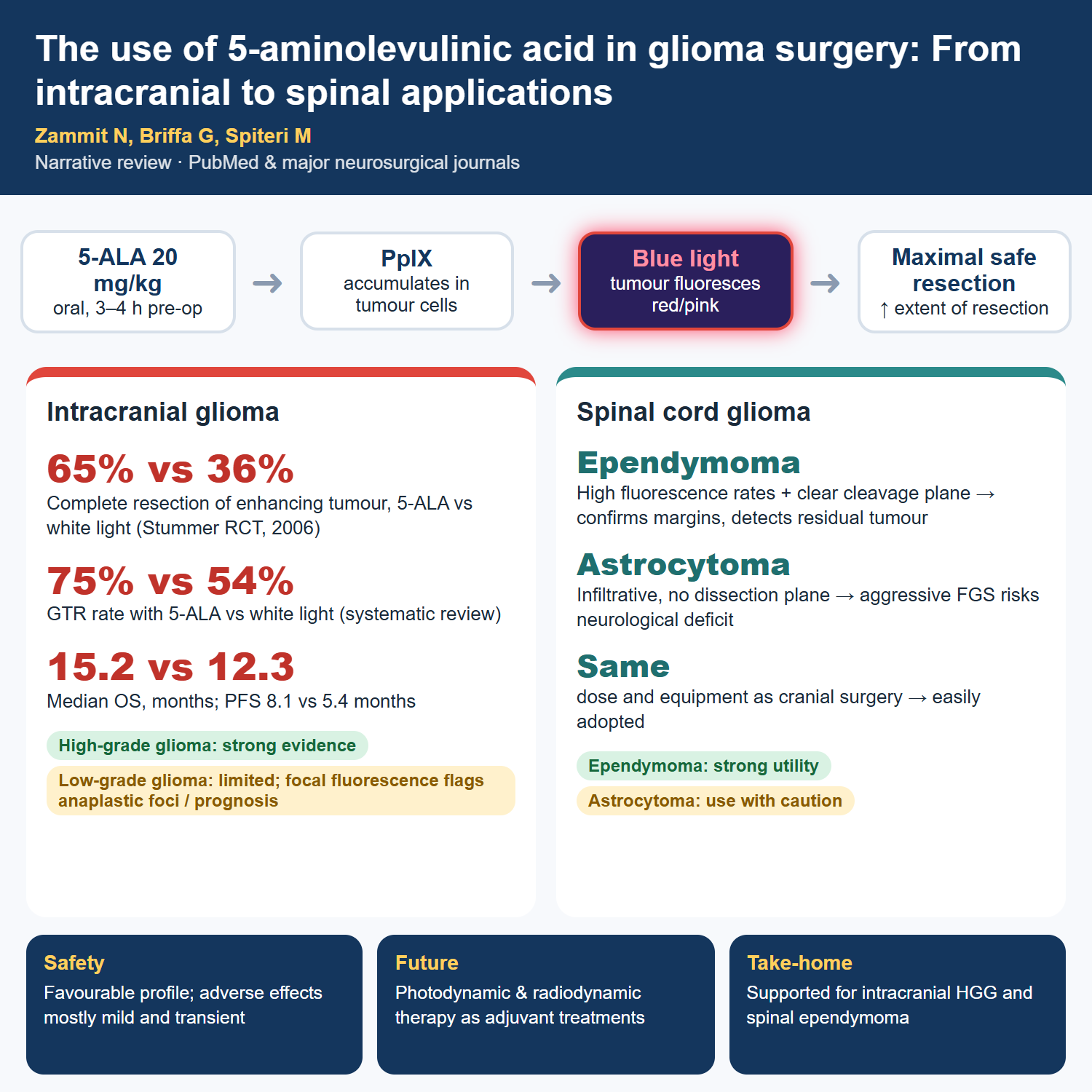
Fluorescence-guided surgery (FGS) with 5-aminolevulinic acid (5-ALA) has become an important adjunct in glioma surgery, with the aim of maximizing the extent of resection while preserving neurological function. After oral or intravenous administration, 5-ALA is metabolized to protoporphyrin IX (PpIX), which preferentially accumulates in tumor cells and fluoresces under blue light, thereby improving intraoperative visualization of malignant tissue. This narrative review summarizes the current indications, evidence, challenges, and future directions of 5-ALA in intracranial and spinal cord glioma surgery. Randomized and observational studies have demonstrated that 5-ALA FGS increases gross total resection rates and improves progression-free and overall survival in intracranial high-grade glioma. Although its role in low-grade glioma is less established, focal fluorescence may identify anaplastic foci and serve as a prognostic marker. In spinal cord gliomas, 5-ALA appears particularly useful for ependymomas, in which high fluorescence rates and favorable resection outcomes have been reported. Its application in spinal astrocytomas requires caution because robust evidence of benefit remains limited and over-resection may cause substantial neurological harm. Overall, 5-ALA has a favorable safety profile, with mostly mild and transient adverse effects. Beyond resection guidance, 5-ALA-based photodynamic and radiodynamic approaches are being explored as adjuvant therapies. Current evidence strongly supports its use in high-grade intracranial gliomas and selected spinal ependymomas, while emerging theranostic applications may further expand its role in multimodal neuro-oncology.
Downloads
References
Stummer W, Stocker S, Wagner S, Stepp H, Fritsch C, Goetz C, et al. Intraoperative detection of malignant gliomas by 5-aminolevulinic acid-induced porphyrin fluorescence. Neurosurgery. 1998;42(3):518-25; discussion 525-6.
Moreno RG, Garcia LMB, Bastidas HI, Tirado CAM, Flores AM, Cabezas JPS, et al. Fluorescence-guided surgery with 5-aminolevulinic acid for resection of spinal cord ependymomas. Asian Spine J. 2019;13(1):119-25.
Eicker SO, Floeth FW, Kamp M, Steiger HJ, Hanggi D. The impact of fluorescence guidance on spinal intradural tumor surgery. Eur Spine J. 2013;22(6):1394-401.
Sipos D, Raposa BL, Freihat O, Simon M, Mekis N, Cornacchione P, et al. Glioblastoma: clinical presentation, multidisciplinary management, and long-term outcomes. Cancers (Basel). 2025;17(1):146.
Aziz PA, Memon SF, Hussain M, Memon AR, Abbas K, Qazi SU, et al. Supratotal resection: an emerging concept of glioblastoma multiforme surgery - systematic review and meta-analysis. World Neurosurg. 2023;179:e46-55.
Jusue-Torres I, Lee J, Germanwala AV, Burns TC, Parney IF. Effect of extent of resection on survival of patients with glioblastoma, IDH-wild-type, WHO grade 4 (WHO 2021): systematic review and meta-analysis. World Neurosurg. 2023;171:e524-32.
Brown TJ, Brennan MC, Li M, Church EW, Brandmeir NJ, Rakszawski KL, et al. Association of the extent of resection with survival in glioblastoma: a systematic review and meta-analysis. JAMA Oncol. 2016;2(11):1460-9.
Bonosi L, Marrone S, Benigno UE, Buscemi F, Musso S, Porzio M, et al. Maximal safe resection in glioblastoma surgery: a systematic review of advanced intraoperative image-guided techniques. Brain Sci. 2023;13(2):216.
Stummer W, Stocker S, Novotny A, Heimann A, Sauer O, Kempski O, et al. In vitro and in vivo porphyrin accumulation by C6 glioma cells after exposure to 5-aminolevulinic acid. J Photochem Photobiol B. 1998;45(2-3):160-9.
US Food and Drug Administration. Drug approval package: Gleolan (aminolevulinic acid hydrochloride). [Internet]. Silver Spring (MD): FDA; 2017 [updated 2018]. https://www.accessdata.fda.gov/drugsatfda_docs/label/2018/208630s003lbl.pdf. cited 03.03.2026.
Stummer W, Pichlmeier U, Meinel T, Wiestler OD, Zanella F, Reulen HJ; ALA-Glioma Study Group. Fluorescence-guided surgery with 5-aminolevulinic acid for resection of malignant glioma: a randomized controlled multicenter phase III trial. Lancet Oncol. 2006;7(5):392-401.
Coburger J, Hagel V, Wirtz CR, Konig R. Surgery for glioblastoma: impact of the combined use of 5-aminolevulinic acid and intraoperative MRI on extent of resection and survival. PLoS One. 2015;10(6):e0131872.
Su X, Huang QF, Chen HL, Chen J. Fluorescence-guided resection of high-grade gliomas: a systematic review and meta-analysis. Photodiagnosis Photodyn Ther. 2014;11(4):451-8.
Schupper AJ, Baron RB, Cheung W, Rodriguez J, Kalkanis SN, Chohan MO, et al. 5-Aminolevulinic acid for enhanced surgical visualization of high-grade gliomas: a prospective, multicenter study. J Neurosurg. 2021;136(6):1525-34.
Valerio JE, de Jesus Aguirre Vera G, Zumaeta J, Rea NS, Fernandez Gomez MP, Mantilla-Farfan P, et al. Comparative analysis of 5-ALA and fluorescent techniques in high-grade glioma treatment. Biomedicines. 2025;13(5):1161.
Ryskeldiyev N, Moldabekov A, Berdibayeva D, Maidan A, Tursynbekov T, Davletov D, et al. Comparative analysis of clinical outcomes in high-grade glioma patients: 5-ALA fluorescence-guided surgery vs. conventional white-light resection. Cancers (Basel). 2025;17(12):1897.
Broekx S, Weyns F, De Vleeschouwer S. 5-Aminolevulinic acid for recurrent malignant gliomas: a systematic review. Clin Neurol Neurosurg. 2020;195:105913.
Ishihara R, Katayama Y, Watanabe T, Yoshino A, Fukushima T, Sakatani K. Quantitative spectroscopic analysis of 5-aminolevulinic acid-induced protoporphyrin IX fluorescence intensity in diffusely infiltrating astrocytomas. Neurol Med Chir (Tokyo). 2007;47(2):53-7; discussion 57.
Jaber M, Wolfer J, Ewelt C, Holling M, Hasselblatt M, Niederstadt T, et al. The value of 5-aminolevulinic acid in low-grade gliomas and high-grade gliomas lacking glioblastoma imaging features: an analysis based on fluorescence, magnetic resonance imaging, 18F-fluoroethyl tyrosine positron emission tomography, and tumor molecular factors. Neurosurgery. 2016;78(3):401-11; discussion 411.
Widhalm G, Wolfsberger S, Minchev G, Woehrer A, Krssak M, Czech T, et al. 5-Aminolevulinic acid is a promising marker for detection of anaplastic foci in diffusely infiltrating gliomas with nonsignificant contrast enhancement. Cancer. 2010;116(6):1545-52.
Suero Molina E, Black D, Kaneko S, Muther M, Stummer W. Double dose of 5-aminolevulinic acid and its effect on protoporphyrin IX accumulation in low-grade glioma. J Neurosurg. 2022;137(4):943-52.
Hosmann A, Millesi M, Wadiura LI, Kiesel B, Mercea PA, Mischkulnig M, et al. 5-ALA fluorescence is a powerful prognostic marker during surgery of low-grade gliomas (WHO grade II) - experience at two specialized centers. Cancers (Basel). 2021;13(11):2540.
Muther M, Jaber M, Johnson TD, Orringer DA, Stummer W. A data-driven approach to predicting 5-aminolevulinic acid-induced fluorescence and World Health Organization grade in newly diagnosed diffuse gliomas. Neurosurgery. 2022;90(6):800-6.
Bianconi A, Bonada M, Zeppa P, Bruno F, La Cava P, Panico F, et al. Double fluorescence-guided surgery with 5-ALA and fluorescein sodium in grade 2 and grade 3 adult-type diffuse gliomas: retrospective analysis of 112 cases. Brain Spine. 2025;5:104277.
Wainwright JV, Endo T, Cooper JB, Tominaga T, Schmidt MH. The role of 5-aminolevulinic acid in spinal tumor surgery: a review. J Neurooncol. 2019;141(3):575-84.
Teixidor P, Arraez MA, Villalba G, Garcia R, Tardaguila M, Gonzalez JJ, et al. Safety and efficacy of 5-aminolevulinic acid for high-grade glioma in usual clinical practice: a prospective cohort study. PLoS One. 2016;11(2):e0149244.
Orillac C, Stummer W, Orringer DA. Fluorescence guidance and intraoperative adjuvants to maximize extent of resection. Neurosurgery. 2021;89(5):727-36.
Dupont C, Mordon S, Deleporte P, Reyns N, Vermandel M. A novel device for intraoperative photodynamic therapy dedicated to glioblastoma treatment. Future Oncol. 2017;13(27):2441-54.
Mahmoudi K, Garvey KL, Bouras A, Cramer G, Stepp H, Jesu Raj JG, et al. 5-Aminolevulinic acid photodynamic therapy for the treatment of high-grade gliomas. J Neurooncol. 2019;141(3):595-607.
Tsai JC, Hsiao YY, Teng LJ, Chen CT, Kao MC. Comparative study on the ALA photodynamic effects of human glioma and meningioma cells. Lasers Surg Med. 1999;24(4):296-305.
Takahashi J, Nagasawa S, Doi M, Takahashi M, Narita Y, Yamamoto J, et al. In vivo study of the efficacy and safety of 5-aminolevulinic radiodynamic therapy for glioblastoma fractionated radiotherapy. Int J Mol Sci. 2021;22(18):9762.
Nordmann NJ, Michael AP. 5-Aminolevulinic acid radiodynamic therapy for treatment of high-grade gliomas: a systematic review. Clin Neurol Neurosurg. 2021;201:106430.
Valdes PA, Leblond F, Jacobs VL, Wilson BC, Paulsen KD, Roberts DW. Quantitative, spectrally resolved intraoperative fluorescence imaging. Sci Rep. 2012;2:798.
Suero Molina E, Azemi G, Ozdemir Z, Russo C, Krahling H, Valls Chavarria A, et al. Predicting intraoperative 5-ALA-induced tumor fluorescence via MRI and deep learning in gliomas with radiographic lower-grade characteristics. J Neurooncol. 2025;171(3):589-98.
Acerbi F, Broggi M, Schebesch KM, Hohne J, Cavallo C, De Laurentis C, et al. Fluorescein-guided surgery for resection of high-grade gliomas: a multicentric prospective phase II study (FLUOGLIO). Clin Cancer Res. 2018;24(1):52-61.
da Silva EB Jr, Ramina R, Neto MC, de Souza Machado GA, Cavalcanti MS, da Silva JFC. Extending the indications of 5-aminolevulinic acid for fluorescence-guided surgery for different central nervous system tumors: a series of 255 cases in Latin America. Arq Bras Neurocir. 2022;41(1):e35-42.
Downloads
- 34 23
Published
Issue
Section
How to Cite
License
Copyright (c) 2026 Neill Zammit, Glenn Briffa, Matthew Spiteri

This work is licensed under a Creative Commons Attribution-NonCommercial-NoDerivatives 4.0 International License.
Citations