First-Trimester Serum Kisspeptin-10 Levels as a Predictor of Spontaneous Abortion: A Prospective Cohort Study
Serum Kisspeptin-10 in Early Pregnancy Loss
Authors
-
Bilal Efe
Department of Obstetrics and Gynecology, Bursa Yüksek İhtisas Training and Research Hospital, Bursa, Türkiye
 https://orcid.org/0009-0006-0944-0768
-
Emin Üstünyurt
Department of Obstetrics and Gynecology, Bursa Yüksek İhtisas Training and Research Hospital, Bursa, Türkiye
https://orcid.org/0000-0001-5602-6785
-
Tayfur Çift
Bursa Yüksek İhtisas Training and Research Hospital
https://orcid.org/0000-0003-4025-9343
-
Muzaffer Temur
Department of Obstetrics and Gynecology, Bursa Yüksek İhtisas Training and Research Hospital, Bursa, Türkiye
https://orcid.org/0000-0001-9388-3882
-
Engin Korkmazer
Department of Obstetrics and Gynecology, Bursa Yüksek İhtisas Training and Research Hospital, Bursa, Türkiye
https://orcid.org/0000-0001-8318-2329

Keywords:
spontaneous abortion, kisspeptin-10, early pregnancy, biomarkerAbstract
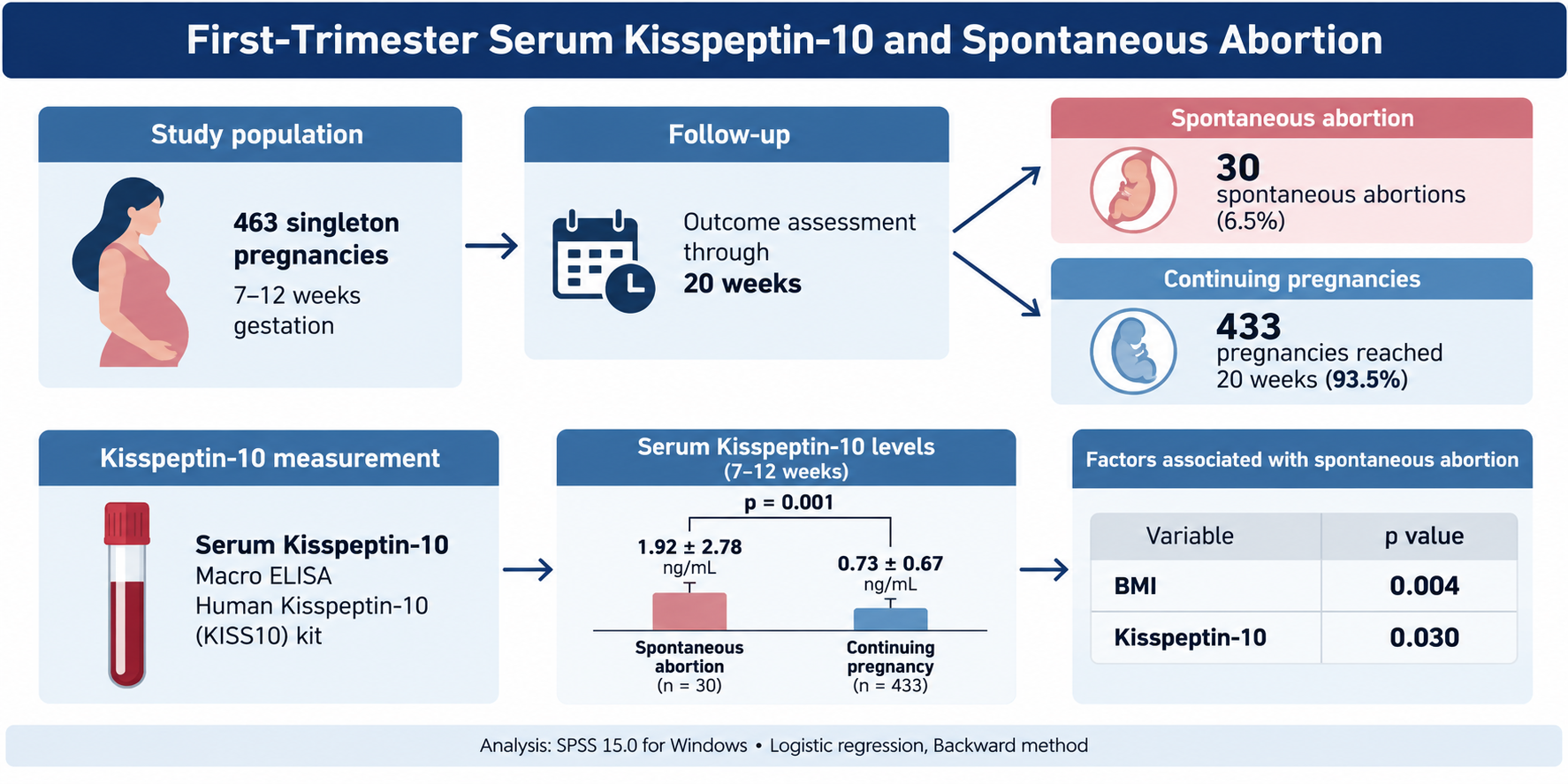
Background/Aim: Spontaneous abortion remains a common complication of early pregnancy, and biomarkers reflecting placental function may improve risk assessment after fetal cardiac activity has been confirmed. This study aimed to evaluate the predictive value of first-trimester serum kisspeptin-10 levels for spontaneous abortion in pregnancies with confirmed fetal cardiac activity.
Methods: This prospective observational study included singleton pregnancies between 7 and 12 weeks of gestation with documented fetal cardiac activity. Serum kisspeptin-10 concentrations were measured using an enzyme-linked immunosorbent assay. Pregnancies resulting in spontaneous abortion before 20 weeks were compared with randomly selected controls whose pregnancies progressed beyond 20 weeks. Univariate and multivariate logistic regression analyses were performed to identify independent predictors of spontaneous abortion.
Results: Among 463 eligible pregnancies, 30 resulted in spontaneous abortion, and 60 controls were selected from pregnancies progressing beyond 20 weeks. Mean serum kisspeptin-10 levels were significantly lower in the spontaneous abortion group than in controls (0.73 (0.67) ng/mL vs. 1.92 (2.78) ng/mL, P = 0.001). Multivariate analysis demonstrated that lower serum kisspeptin-10 levels (P = 0.030) and higher body mass index (P = 0.004) were independently associated with spontaneous abortion.
Conclusion: Lower first-trimester serum kisspeptin-10 levels are associated with an increased risk of spontaneous abortion in pregnancies with confirmed fetal cardiac activity. Kisspeptin-10 may serve as a supplementary biomarker for early pregnancy risk stratification.
Downloads
References
Magnus MC, Wilcox AJ, Morken NH, Weinberg CR, Håberg SE. Role of maternal age and pregnancy history in risk of miscarriage: prospective register based study. BMJ. 2019;364:l869. https://doi.org/10.1136/bmj.l869
George JS, Mortimer R, Anchan RM. Clinical updates in the management of recurrent pregnancy loss (RPL). Curr Obstet Gynecol Rep. 2022;11(2):118-24. https://doi.org/10.1007/s13669-022-00328-5
Turesheva A, Aimagambetova G, Ukybassova T, Marat A, Kanabekova P, Kaldygulova L, et al. Recurrent pregnancy loss etiology, risk factors, diagnosis, and management. Fresh look into a full box. J Clin Med. 2023;12(12):4074. https://doi.org/10.3390/jcm12124074
Petersen JF, Friis-Hansen LJ, Bryndorf T, Jensen AK, Andersen AN, Løkkegaard E. A novel approach to predicting early pregnancy outcomes dynamically in a prospective cohort using repeated ultrasound and serum biomarkers. Reprod Sci. 2023;30(12):3597-609. https://doi.org/10.1007/s43032-023-01323-8
Tsutsui K, Ubuka T. Photoperiodism in mammalian reproduction. In: Skinner MK, editor. Encyclopedia of Reproduction. 2nd ed. Vol. 6. Oxford: Academic Press; 2018. p. 415-9. https://doi.org/10.1016/B978-0-12-809633-8.20586-4
Xie Q, Kang Y, Zhang C, Xie Y, Wang C, Liu J, et al. The role of kisspeptin in the control of the hypothalamic-pituitary-gonadal axis and reproduction. Front Endocrinol (Lausanne). 2022;13:925206. https://doi.org/10.3389/fendo.2022.925206
Oakley AE, Clifton DK, Steiner RA. Kisspeptin signaling in the brain. Endocr Rev. 2009;30(6):713-43. https://doi.org/10.1210/er.2009-0005
Gomes VCL, Sones JL. From inhibition of trophoblast cell invasion to proapoptosis: what are the potential roles of kisspeptins in preeclampsia? Am J Physiol Regul Integr Comp Physiol. 2021;321(1):R41-8. https://doi.org/10.1152/ajpregu.00258.2020
Hiden U, Bilban M, Knöfler M, Desoye G. Kisspeptins and the placenta: regulation of trophoblast invasion. Rev Endocr Metab Disord. 2007;8(1):31-9. https://doi.org/10.1007/s11154-007-9030-8
Francis VA, Abera AB, Matjila M, Millar RP, Katz AA. Kisspeptin regulation of genes involved in cell invasion and angiogenesis in first trimester human trophoblast cells. PLoS One. 2014;9(6):e99680. https://doi.org/10.1371/journal.pone.0099680
Panting EN, Weight JH, Sartori JA, Coall DA, Smith JT. The role of placental kisspeptin in trophoblast invasion and migration: an assessment in Kiss1r knockout mice, BeWo cell lines and human term placenta. Reprod Fertil Dev. 2024;36(11):RD23230. https://doi.org/10.1071/RD23230
Ye S, Zhou L. Role of serum kisspeptin as a biomarker to detect miscarriage: a systematic review and meta-analysis. Hum Fertil (Camb). 2024;27(1):2417934. https://doi.org/10.1080/14647273.2024.2417934
Liu L, Lin Z, Lai X, Wu S. Circulating kisspeptin levels in spontaneous abortion: a systematic review and meta-analysis. Clin Exp Obstet Gynecol. 2023;50(5):101. https://doi.org/10.31083/j.ceog5005101
Jauniaux E, Burton GJ. Pathophysiology of histological changes in early pregnancy loss. Placenta. 2005;26(2-3):114-23. https://doi.org/10.1016/j.placenta.2004.05.011
Memtsa M, Jurkovic D, Jauniaux ERM, Royal College of Obstetricians and Gynaecologists. Diagnostic biomarkers for predicting adverse early pregnancy outcomes. BJOG. 2019;126(3):e107-13. https://doi.org/10.1111/1471-0528.15468
Musa E, Matjila M, Levitt NS. Kisspeptins and glucose homeostasis in pregnancy: implications for gestational diabetes mellitus-a review article. Reprod Sci. 2022;29(2):321-7. https://doi.org/10.1007/s43032-020-00437-7
Bowe JE, Hill TG, Hunt KF, Smith LIF, Simpson SJS, Amiel SA, et al. A role for placental kisspeptin in β cell adaptation to pregnancy. JCI Insight. 2019;4(20):e124540. https://doi.org/10.1172/jci.insight.124540
da Silva PHA, de Melo Romão LG, de Freitas NPA, Carvalho TR, Porto MEMP, Araujo Júnior E, et al. Kisspeptin as a predictor of miscarriage: a systematic review. J Matern Fetal Neonatal Med. 2023;36(1):2197097. https://doi.org/10.1080/14767058.2023.2197097
Li H, Zhang W, Sun X. A prospective study to evaluate whether serum kisspeptin is a marker predictive of the first-trimester miscarriage of women who conceive in IVF. J Assist Reprod Genet. 2024;41(1):79-85. https://doi.org/10.1007/s10815-023-02974-x
Abbara A, Al-Memar M, Phylactou M, Daniels E, Patel B, Eng PC, et al. Changes in circulating kisspeptin levels during each trimester in women with antenatal complications. J Clin Endocrinol Metab. 2022;107(1):e71-83. https://doi.org/10.1210/clinem/dgab617
Metwally M, Ong KJ, Ledger WL, Li TC. Does high body mass index increase the risk of miscarriage after spontaneous and assisted conception? A meta-analysis of the evidence. Fertil Steril. 2008;90(3):714-26. https://doi.org/10.1016/j.fertnstert.2007.07.1290
Downloads
- 35 10
Published
Issue
Section
How to Cite
License
Copyright (c) 2026 Bilal Efe, Emin Üstünyurt, Tayfur Çift, Muzaffer Temur, Engin Korkmazer

This work is licensed under a Creative Commons Attribution-NonCommercial-NoDerivatives 4.0 International License.
Citations