The impact of COVID-19 on mammography screening: Trends in Türkiye between 2018 and 2023
The impact of COVID-19 on mammography screening
Authors
-
Mehmet Demir
Department of Radiology, Faculty of Medicine, Kahramanmaraş Sütçü İmam University, Kahramanmaraş, Türkiye
 https://orcid.org/0000-0002-5031-6324
-
Feza Demir
Department of Public Health, Faculty of Medicine, Kahramanmaraş Sütçü İmam University, Kahramanmaraş, Türkiye
https://orcid.org/0000-0002-6377-1545

Keywords:
Mammography, Breast Cancer Screening, COVID-19 PandemicAbstract
Background/Aim: Breast cancer screening programs are essential for early detection, but they may be disrupted during major public health crises. This study evaluated trends in mammography screening, breast biopsy numbers, and malignancy detection rates in Türkiye between 2018 and 2023, with particular attention to the effects of the COVID-19 pandemic.
Methods: This descriptive study used nationwide mammography screening data obtained from the Health Statistics Yearbooks of the Republic of Türkiye Ministry of Health for 2018-2023. In addition, breast biopsy data and malignancy rates from the interventional radiology unit of the study center were reviewed for the same period. Annual changes were analyzed to assess the effect of the pandemic and the subsequent recovery period on breast cancer screening and diagnosis.
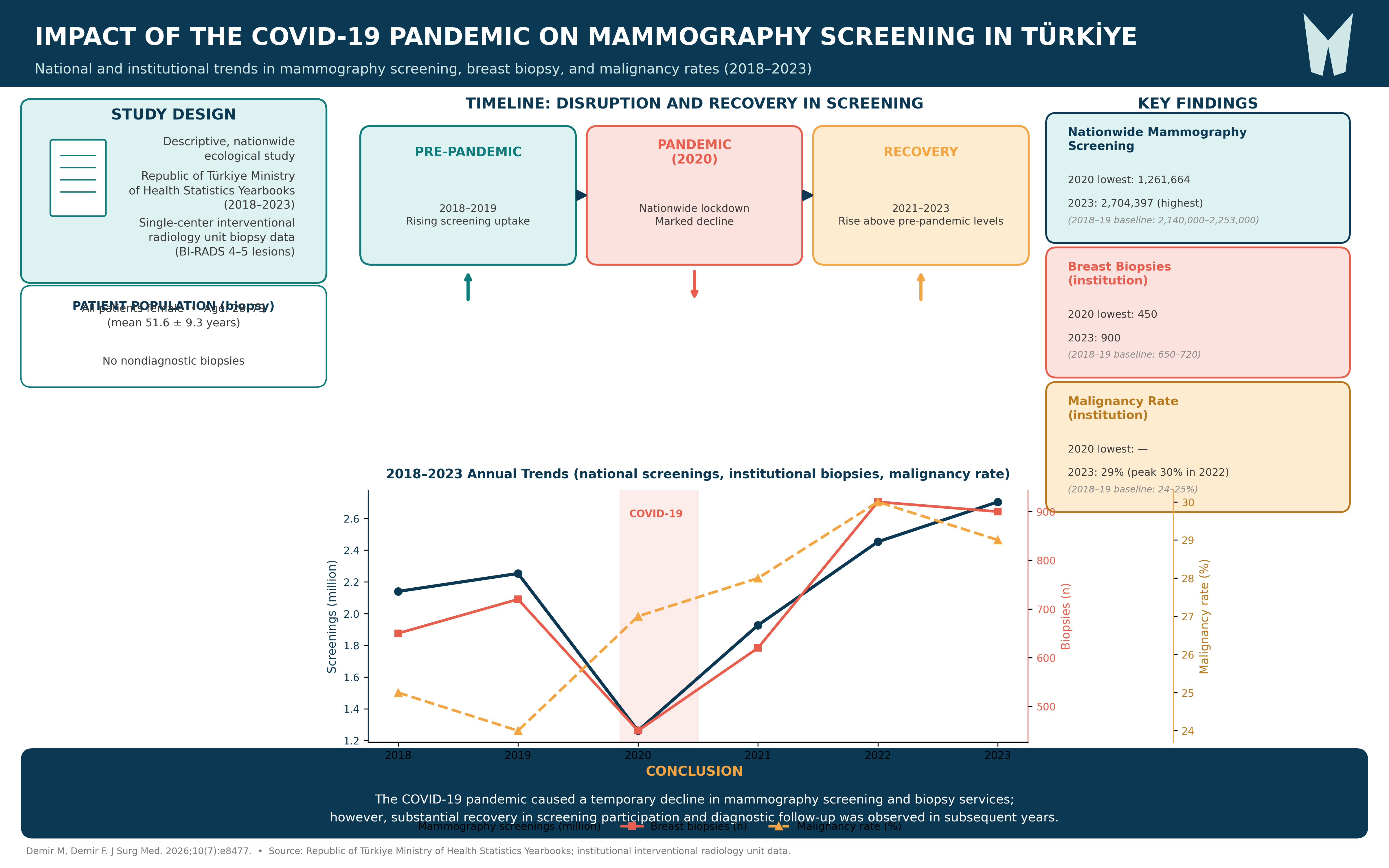
Results: Nationwide mammography screenings increased from 2,139,813 in 2018 to 2,252,815 in 2019 and then decreased markedly to 1,261,664 in 2020. A recovery trend was observed in 2021 (1,926,717) and continued through 2022 (2,453,042) and 2023 (2,704,397). Similarly, the number of breast biopsies decreased from 720 in 2019 to 450 in 2020, then increased to 920 in 2022 and slightly decreased to 900 in 2023. Malignancy rates increased from 24.0% in 2019 to 30.0% in 2022 and then slightly decreased to 29.0% in 2023.
Conclusion: The COVID-19 pandemic temporarily disrupted breast cancer screening and biopsy services in Türkiye. However, substantial recovery was observed in subsequent years in both screening participation and diagnostic follow-up. These findings underscore the importance of resilient health care systems and strategies that sustain cancer screening services during public health crises.
Downloads
References
Anastasiadi Z, Lianos GD, Ignatiadou E, Harissis HV, Mitsis M. Breast cancer in young women: An overview. Updates Surg. 2017;69(3):313-7. doi: 10.1007/s13304-017-0424-1. DOI: https://doi.org/10.1007/s13304-017-0424-1
Sung H, Ferlay J, Siegel RL, Laversanne M, Soerjomataram I, Jemal A, et al. Global cancer statistics 2020: GLOBOCAN estimates of incidence and mortality worldwide for 36 cancers in 185 countries. CA Cancer J Clin. 2021;71(3):209-49. doi: 10.3322/caac.21660. DOI: https://doi.org/10.3322/caac.21660
Freedman RA, Partridge AH. Management of breast cancer in very young women. Breast. 2013;22 Suppl 2:S176-9. doi: 10.1016/j.breast.2013.07.034. DOI: https://doi.org/10.1016/j.breast.2013.07.034
Jackson VP. Diagnostic mammography. Radiol Clin North Am. 2004;42(5):853-70. doi: 10.1016/j.rcl.2004.06.002. DOI: https://doi.org/10.1016/j.rcl.2004.06.002
Løberg M, Lousdal ML, Bretthauer M, Kalager M. Benefits and harms of mammography screening. Breast Cancer Res. 2015;17(1):63. doi: 10.1186/s13058-015-0525-z. DOI: https://doi.org/10.1186/s13058-015-0525-z
Luleci D, Kilic B. Factors affecting women's participation in breast cancer screening in Turkey. Asian Pac J Cancer Prev. 2022;23(5):1627-34. doi: 10.31557/APJCP.2022.23.5.1627. DOI: https://doi.org/10.31557/APJCP.2022.23.5.1627
Republic of Türkiye Ministry of Health. Health Statistics Yearbooks [Internet]. Ankara: General Directorate of Health Information Systems; 2024 [cited 2025 Apr 1]. Available from: https://www.saglik.gov.tr/TR-84930/saglik-istatistikleri-yilliklari.html.
Song H, Bergman A, Chen AT, Ellis D, David G, Friedman AB, et al. Disruptions in preventive care: Mammograms during the COVID-19 pandemic. Health Serv Res. 2021;56(1):95-101. doi: 10.1111/1475-6773.13596. DOI: https://doi.org/10.1111/1475-6773.13596
Sprague BL, Lowry KP, Miglioretti DL, Alsheik N, Bowles EJA, Tosteson ANA, et al. Changes in mammography use by women's characteristics during the first 5 months of the COVID-19 pandemic. J Natl Cancer Inst. 2021;113(9):1161-7. doi: 10.1093/jnci/djab045. DOI: https://doi.org/10.1093/jnci/djab045
Gathani T, Dodwell D, Horgan K. The impact of the first 2 years of the COVID-19 pandemic on breast cancer diagnoses: A population-based study in England. Br J Cancer. 2023;128(3):481-3. doi: 10.1038/s41416-022-02054-4. DOI: https://doi.org/10.1038/s41416-022-02054-4
Ng JS, Hamilton DG. Assessing the impact of the COVID-19 pandemic on breast cancer screening and diagnosis rates: A rapid review and meta-analysis. J Med Screen. 2022;29(4):209-18. doi: 10.1177/09691413221101807. DOI: https://doi.org/10.1177/09691413221101807
Grimm LJ, Lee C, Rosenberg RD, Burleson J, Simanowith M, Fruscello T Jr, et al. Impact of the COVID-19 pandemic on breast imaging: An analysis of the National Mammography Database. J Am Coll Radiol. 2022;19(8):919-34. doi: 10.1016/j.jacr.2022.04.008. DOI: https://doi.org/10.1016/j.jacr.2022.04.008
van den Bruele AB, Sevilimedu V, Jochelson M, Formenti S, Norton L, Sacchini V. Mobile mammography in New York City: Analysis of 32,350 women utilizing a screening mammogram program. NPJ Breast Cancer. 2022;8(1):14. doi: 10.1038/s41523-022-00381-6. DOI: https://doi.org/10.1038/s41523-022-00381-6
Rahman WT, Helvie MA. Breast cancer screening in average and high-risk women. Best Pract Res Clin Obstet Gynaecol. 2022;83:3-14. doi: 10.1016/j.bpobgyn.2021.11.007. DOI: https://doi.org/10.1016/j.bpobgyn.2021.11.007
Duffy SW, Seedat F, Kearins O, Press M, Walton J, Myles J, et al. The projected impact of the COVID-19 lockdown on breast cancer deaths in England due to the cessation of population screening: A national estimation. Br J Cancer. 2022;126(9):1355-61. doi: 10.1038/s41416-022-01714-9. DOI: https://doi.org/10.1038/s41416-022-01714-9
Seely JM, Alhassan T. Screening for breast cancer in 2018-what should we be doing today? Curr Oncol. 2018;25(Suppl 1):S115-24. doi: 10.3747/co.25.3770. DOI: https://doi.org/10.3747/co.25.3770
Downloads
- 235 228
Published
Issue
Section
How to Cite
License
Copyright (c) 2026 Mehmet Demir, Feza Demir

This work is licensed under a Creative Commons Attribution-NonCommercial-NoDerivatives 4.0 International License.
Citations