Early functional outcomes of proximal femur fractures treated with proximal femoral nailing in a tertiary trauma center
Proximal femur fractures treated with PFN
Authors
-
Kayode Odejobi
NATIONAL ORTHOPAEDIC HOSPITAL, LAGOS
 https://orcid.org/0009-0008-1018-8429
-
Kehinde Adesola Alatishe
National Orthopaedic Hospital Igbobi Lagos
https://orcid.org/0000-0002-9564-249X
-
Ugochuku Akpati
NATIONAL ORTHOPAEDIC HOSPITAL, LAGOS
https://orcid.org/0009-0001-0499-5776

Keywords:
proximal femur fracture, proximal femoral nailing, functional outcomes, LEFS, SF-36Abstract
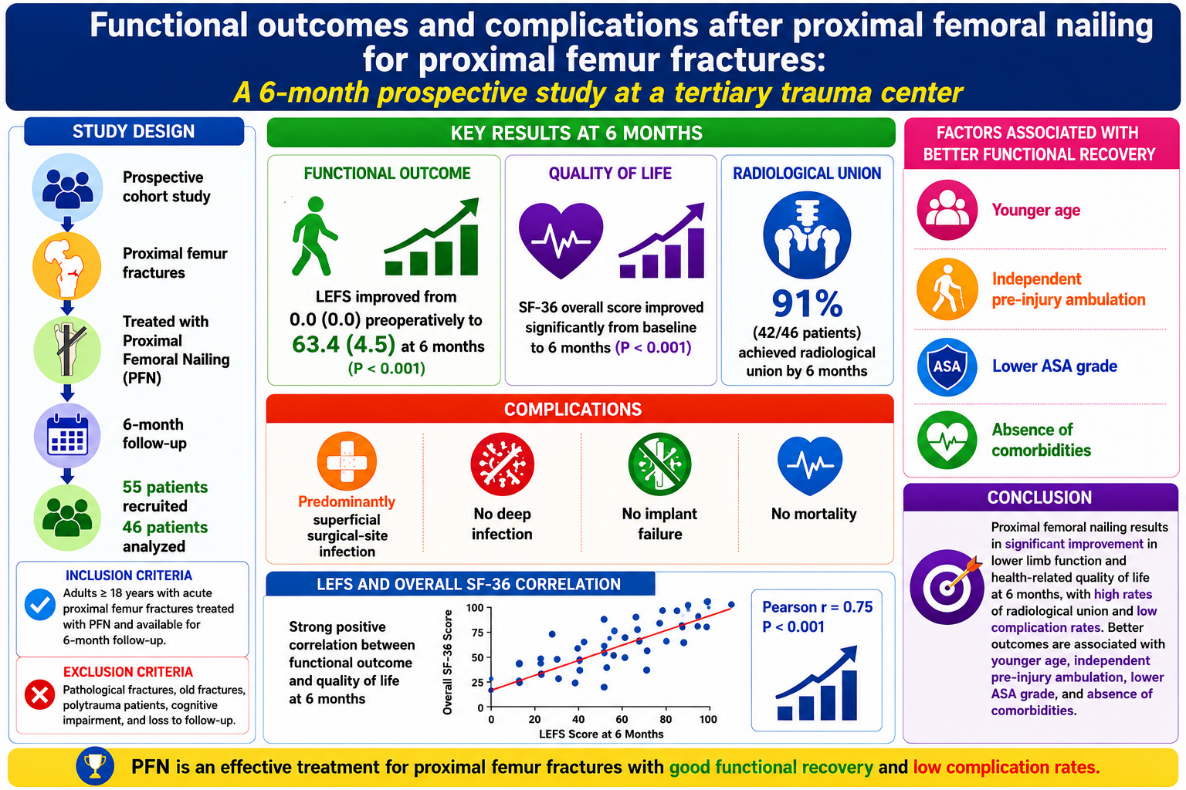
Background/Aim: Proximal femur fractures are common and often debilitating, particularly in older adults with osteoporosis and a high risk of falls. In younger individuals, these injuries usually result from high-energy trauma. Proximal femoral nailing has gained acceptance as a reliable fixation method that may enable early mobilization and functional recovery. This study evaluated the early functional outcomes and complications of proximal femoral nailing in patients managed at a tertiary trauma center.
Methods: This prospective cohort included 55 patients with proximal femur fractures treated with proximal femoral nailing; 46 patients completed follow-up and were included in the final analysis. Functional outcomes were assessed over 6 months using the Lower Extremity Functional Scale and the Short Form-36 health survey, together with clinical and radiological evaluation. Data were analyzed using IBM SPSS Statistics for Windows, version 23. Continuous variables were summarized as mean (SD), and categorical variables as frequencies and percentages. Appropriate parametric and nonparametric tests were used, with statistical significance set at P < 0.05.
Results: The mean age was 57.9 (13.0) years, and the male-to-female ratio was 1.7:1. The radiological union rate was 91%, with a mean time to union of 3.9 (0.2) months. Lower Extremity Functional Scale and Short Form-36 scores improved progressively during follow-up. Poorer functional outcomes were associated with comorbidities, pre-injury use of walking aids, female sex, older age, higher American Society of Anesthesiologists grade, and surgery delayed beyond 48 hours. Complications occurred in 13% (n = 6) of patients, predominantly superficial surgical site infections. Surgical site infection was associated with comorbidities (P = 0.040) and showed a borderline association with increasing age (P = 0.048).
Conclusion: Proximal femoral nailing provided reliable fixation, a high union rate, and meaningful early functional recovery in this cohort. Patient baseline characteristics and timing of surgery were associated with recovery. Larger multicenter studies with longer follow-up are needed to confirm these findings.
Downloads
References
Dyer SM, Crotty M, Fairhall N, Magaziner J, Beaupre LA, Cameron ID, et al. A critical review of the long-term disability outcomes following hip fracture. BMC Geriatr. 2016;16:158. doi: 10.1186/s12877-016-0332-0. DOI: https://doi.org/10.1186/s12877-016-0332-0
Hwang LC, Lo WH, Chen WM, Lin CF, Huang CK, Chen CM. Intertrochanteric fractures in adults younger than 40 years of age. Arch Orthop Trauma Surg. 2001;121(3):123-6. doi: 10.1007/s004020000190. DOI: https://doi.org/10.1007/s004020000190
Dhanwal DK, Dennison EM, Harvey NC, Cooper C. Epidemiology of hip fracture: worldwide geographic variation. Indian J Orthop. 2011;45(1):15-22. doi: 10.4103/0019-5413.73656. DOI: https://doi.org/10.4103/0019-5413.73656
Adebajo AO, Cooper C, Evans JG. Fractures of the hip and distal forearm in West Africa and the United Kingdom. Age Ageing. 1991;20(6):435-8. doi: 10.1093/ageing/20.6.435. DOI: https://doi.org/10.1093/ageing/20.6.435
Schnaid E, MacPhail AP, Sweet MBE. Fractured neck of femur in black patients: a prospective study. J Bone Joint Surg Br. 2000;82(6):872-5. doi: 10.1302/0301-620X.82B6.10589. DOI: https://doi.org/10.1302/0301-620X.82B6.0820872
Zebaze RMD, Seeman E. Epidemiology of hip and wrist fractures in Cameroon, Africa. Osteoporos Int. 2003;14(4):301-5. doi: 10.1007/s00198-002-1356-1. DOI: https://doi.org/10.1007/s00198-002-1356-1
Boldin C, Seibert FJ, Fankhauser F, Peicha G, Grechenig W, Szyszkowitz R. The proximal femoral nail (PFN): a minimal invasive treatment of unstable proximal femoral fractures. A prospective study of 55 patients with a follow-up of 15 months. Acta Orthop Scand. 2003;74(1):53-8. doi: 10.1080/00016470310013662. DOI: https://doi.org/10.1080/00016470310013662
Yadav S, Golhar AV, Agrawal R. Management of unstable intertrochanteric fracture by proximal femoral nail. J Evol Med Dent Sci. 2014;3(15):4084-102. doi: 10.14260/jemds/2014/2403. DOI: https://doi.org/10.14260/jemds/2014/2403
Chopra BL, Kumar K, Khajotia BL, Bhambu R, Bhatiwal S, Shekhawat V. Proximal femoral nail: outcome and complications. A prospective study of 125 cases of proximal femoral fractures. Int J Res Orthop. 2017;3(5):973-8. doi: 10.18203/issn.2455-4510.IntJResOrthop20173673. DOI: https://doi.org/10.18203/issn.2455-4510.IntJResOrthop20173673
Takahashi A, Naruse H, Kitade I, Shimada S, Tsubokawa M, Kokubo Y, et al. Functional outcomes after the treatment of hip fracture. PLoS One. 2020;15(7):e0236652. doi: 10.1371/journal.pone.0236652. DOI: https://doi.org/10.1371/journal.pone.0236652
Chang SM, Zhang YQ, Ma Z, Li Q, Dargel J, Eysel P. Fracture reduction with positive medial cortical support: a key element in stability reconstruction for the unstable pertrochanteric hip fractures. Arch Orthop Trauma Surg. 2015;135(6):811-8. doi: 10.1007/s00402-015-2206-x. DOI: https://doi.org/10.1007/s00402-015-2206-x
Zelenka L, Alt J, Knížková I, Kunc P, Lukešová D. Epidemiologická studie vlivu pohlaví, věku, mobility a doby úrazu na zlomeniny proximálního femuru [Epidemiological study of the effects of gender, age, mobility and time of injury on proximal femoral fractures]. Acta Chir Orthop Traumatol Cech. 2018;85(1):40-5. DOI: https://doi.org/10.55095/achot2018/006
Bartoníček J, Dzupa V, Fric V, Pacovský V, Skála-Rosenbaum J, Svatoš F. Epidemiologie a ekonomie zlomenin proximálního femuru, proximálního humeru, distálního radia a luxačních zlomenin hlezna [Epidemiology and economic implications of fractures of the proximal femur, proximal humerus, distal radius and fracture-dislocation of the ankle]. Rozhl Chir. 2008;87(4):213-9.
Hantouly AT, AlBarazanji A, Al-Juboori M, Alebbini M, Toubasi AA, Mohammed A, et al. Epidemiology of proximal femur fractures in the young population of Qatar. Eur J Orthop Surg Traumatol. 2024;34(1):21-9. doi: 10.1007/s00590-023-03664-1. DOI: https://doi.org/10.1007/s00590-023-03664-1
Chang SM, Wang ZH, Tian KW, Sun GX, Wang X, Rui YF. A sophisticated fracture classification system of the proximal femur trochanteric region (AO/OTA-31A) based on 3D-CT images. Front Surg. 2022;9:919225. doi: 10.3389/fsurg.2022.919225. DOI: https://doi.org/10.3389/fsurg.2022.919225
Haslhofer DJ, Stiftinger JM, Kraml N, Dannbauer F, Schmolmüller C, Gotterbarm T, et al. Complication rates after proximal femoral nailing: does level of training matter? J Orthop Traumatol. 2023;24(1):56. doi: 10.1186/s10195-023-00737-z. DOI: https://doi.org/10.1186/s10195-023-00737-z
Song H, Hu SJ, Du SC, Xiong WF, Chang SM. Sub-classification of AO/OTA-2018 pertrochanteric fractures is associated with clinical outcomes after fixation of intramedullary nails. Geriatr Orthop Surg Rehabil. 2021;12:21514593211056739. doi: 10.1177/21514593211056739. DOI: https://doi.org/10.1177/21514593211056739
Wang Z, Li K, Peng C. Six-part classification of femoral intertrochanteric fractures: a classification method to improve the diagnosis rate of unstable fractures. Orthop Surg. 2024;16(3):637-53. doi: 10.1111/os.13998. DOI: https://doi.org/10.1111/os.13998
Mehta SP, Fulton A, Quach C, Thistle M, Toledo C, Evans NA. Measurement properties of the Lower Extremity Functional Scale: a systematic review. J Orthop Sports Phys Ther. 2016;46(3):200-16. doi: 10.2519/jospt.2016.6165. DOI: https://doi.org/10.2519/jospt.2016.6165
Chopra M, Srivastava SK, Kumar S, Mishra DK. Functional and radiological outcomes of intertrochanteric fractures treated with proximal femoral nail. Int J Res Orthop. 2020;6(5):1001-7. doi: 10.18203/issn.2455-4510.IntJResOrthop20203721. DOI: https://doi.org/10.18203/issn.2455-4510.IntJResOrthop20203721
Korkmaz MF, Erdem MN, Disli Z, Selcuk EB, Karakaplan M, Gogus A. Outcomes of trochanteric femoral fractures treated with proximal femoral nail: an analysis of 100 consecutive cases. Clin Interv Aging. 2014;9:569-74. doi: 10.2147/CIA.S59835. DOI: https://doi.org/10.2147/CIA.S59835
Zahoor HUR, Khatana NH, Iqbal S, Mahmood U, Ahmed S, Laeeque O. Functional outcome of proximal femoral nail antirotation (PFNA) in proximal femur fracture. J Health Rehabil Res. 2024;4(1):905-10. doi: 10.61919/jhrr.v4i1.442. DOI: https://doi.org/10.61919/jhrr.v4i1.442
van der Sijp MPL, van Eijk M, Tong WH, Niggebrugge AHP, Schoones JW, Blauw GJ, et al. Independent factors associated with long-term functional outcomes in patients with a proximal femoral fracture: a systematic review. Exp Gerontol. 2020;139:111035. doi: 10.1016/j.exger.2020.111035. DOI: https://doi.org/10.1016/j.exger.2020.111035
Balachandran R, Karthikeyan M, Vikram M, Pratheeban K. Analysis of factors affecting the radiological and functional outcome of proximal femoral nailing in unstable intertrochanteric fractures. Int J Orthop Sci. 2020;6(1):376-8. doi: 10.22271/ortho.2020.v6.i1g.1893. DOI: https://doi.org/10.22271/ortho.2020.v6.i1g.1893
Verma AK, Dhiman P, Sharma V. General health and functional improvement among patients with unstable extracapsular proximal femoral fractures managed with proximal femoral nail by using SF-36 score. Int J Res Orthop. 2022;8(5):565-70. doi: 10.18203/issn.2455-4510.IntJResOrthop20222187. DOI: https://doi.org/10.18203/issn.2455-4510.IntJResOrthop20222187
Guyver PM, McCarthy MJH, Jain NPM, Keenan J. The short-term functional and radiological outcome of patients treated with the Synthes proximal femoral nail antirotation (PFNA) for unstable proximal femoral fractures. Eur J Orthop Surg Traumatol. 2011;21:493-501. doi: 10.1007/s00590-010-0745-y. DOI: https://doi.org/10.1007/s00590-010-0745-y
Abdulkasem N, Phinyo P, Khorana J, Pruksakorn D, Apivatthakakul T. Prognostic factors of 1-year postoperative functional outcomes of older patients with intertrochanteric fractures in Thailand: a retrospective cohort study. Int J Environ Res Public Health. 2021;18(13):6896. doi: 10.3390/ijerph18136896. DOI: https://doi.org/10.3390/ijerph18136896
Altintas B, Biber R, Bail HJ. The learning curve of proximal femoral nailing. Acta Orthop Traumatol Turc. 2014;48(4):396-400. doi: 10.3944/AOTT.2014.13.0056. DOI: https://doi.org/10.3944/AOTT.2014.13.0056
Owens CD, Stoessel K. Surgical site infections: epidemiology, microbiology and prevention. J Hosp Infect. 2008;70 Suppl 2:3-10. doi: 10.1016/S0195-6701(08)60017-1. DOI: https://doi.org/10.1016/S0195-6701(08)60017-1
Anderson DJ, Podgorny K, Berríos-Torres SI, Bratzler DW, Dellinger EP, Greene L, et al. Strategies to prevent surgical site infections in acute care hospitals: 2014 update. Infect Control Hosp Epidemiol. 2014;35(6):605-27. doi: 10.1086/676022. DOI: https://doi.org/10.1086/676022
Liu H, Wang Y, Xing H, Chang Z, Pan J. Risk factors for deep surgical site infections following orthopedic trauma surgery: a meta-analysis and systematic review. J Orthop Surg Res. 2024;19:811. doi: 10.1186/s13018-024-05299-2. DOI: https://doi.org/10.1186/s13018-024-05299-2
Patel I, Amin TK, Kachhad KH, Patel KM, Senta A, Modi DR, et al. Results of proximal femoral nailing in subtrochanteric fracture of femur in adults. J Orthop Dis Traumatol. 2022;5(2):74-7. doi: 10.4103/jodp.jodp_4_22. DOI: https://doi.org/10.4103/jodp.jodp_4_22
Gupta S, Gupta P, Raina GS, Kumar M, Singh G. Functional outcome of long proximal femoral nail versus short proximal femoral nail in peritrochanteric fractures. Int J Res Med Sci. 2021;9(5):1479-81. doi: 10.18203/2320-6012.ijrms20211415. DOI: https://doi.org/10.18203/2320-6012.ijrms20211415
Haentjens P, Magaziner J, Colón-Emeric CS, Vanderschueren D, Milisen K, Velkeniers B, et al. Meta-analysis: excess mortality after hip fracture among older women and men. Ann Intern Med. 2010;152(6):380-90. DOI: https://doi.org/10.7326/0003-4819-152-6-201003160-00008
Downloads
- 340 474
Published
Issue
Section
How to Cite
License
Copyright (c) 2026 Kayode Odejobi, Kehinde Adesola Alatishe, Ugochuku Akpati

This work is licensed under a Creative Commons Attribution-NonCommercial-NoDerivatives 4.0 International License.
Citations