Reconstruction of choledochal wall defects with autogenous pediculated gallbladder
Reconstruction of choledochal wall defects
Authors
-
Mehmet Hatip Adıgüzel
Department of General Surgery, Mersin City Training and Research Hospital, Mersin, Turkey
 https://orcid.org/0009-0005-7249-0912
-
Guvenc Diner
Department of General Surgery, Mersin City Training and Research Hospital, Mersin, Turkey
https://orcid.org/0000-0002-7732-4092
-
Recep Çağlar
Department of General Surgery / Gastroenterological Surgery, Mersin City Training and Research Hospital, Mersin, Turkey
https://orcid.org/0000-0003-0987-9202

Keywords:
reconstruction, choledochal wall defect, autogenous pediculated gallbladder, biliary injury, experimental modelAbstract
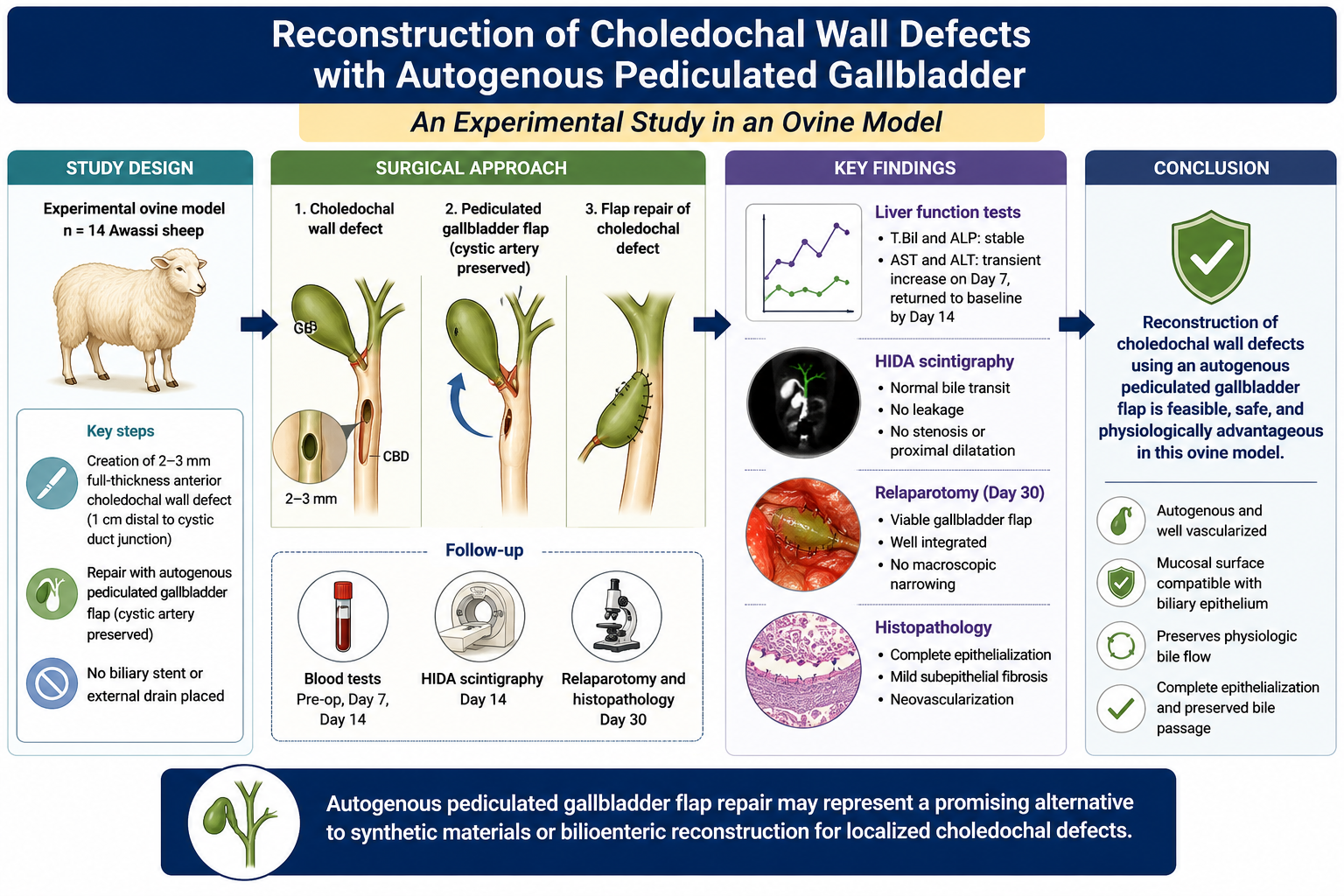
Background/Aim: Biliary tract injuries with tissue loss remain challenging in hepatobiliary surgery. Primary repair, bilioenteric anastomosis, and various graft materials have been used; however, each approach has limitations, including stenosis, infection, and foreign-body reaction. This study aimed to evaluate the feasibility and effectiveness of an autogenous pediculated gallbladder flap for reconstructing choledochal wall defects in an experimental ovine model.
Methods: Fourteen Awassi sheep underwent surgical creation of a 2-3 mm full-thickness anterior choledochal wall defect located 1 cm distal to the cystic duct junction. The defect was repaired using an autogenous pediculated gallbladder flap without biliary stenting. Blood samples were obtained preoperatively and on postoperative days 7 and 14 to measure total bilirubin, AST, ALT, and ALP. Hepatobiliary scintigraphy with Tc-99m HIDA was performed on postoperative day 14. On day 30, surviving animals underwent relaparotomy and histopathological examination.
Results: Three animals died early postoperatively due to anesthesia-related cardiopulmonary complications and were excluded from the analysis. Eleven animals completed follow-up. Total bilirubin and ALP did not differ significantly across time points. AST and ALT increased on postoperative day 7 compared with baseline and returned to baseline by postoperative day 14. Scintigraphy showed normal bile transit without leakage, stenosis, or proximal dilatation. Macroscopic and histopathological evaluation confirmed flap viability and complete epithelialization.
Conclusion: Reconstruction of choledochal wall defects using an autogenous pediculated gallbladder flap appears safe and physiologically advantageous in this ovine model. Preserved mucosa, intact vascularity, and autogenous tissue characteristics support its potential as an alternative to synthetic materials or bilioenteric reconstruction.
Downloads
References
Thomas MN, Stippel DL. Management of bile duct injuries. Chirurg. 2020;91(1):18-22. doi: 10.1007/s00104-019-01060-2. DOI: https://doi.org/10.1007/s00104-019-01060-2
Aydin M, Bakir B, Kösem M, Kisli E, Gençcelep M. Biliary tract reconstruction with autologous rectus sheath graft: an experimental study. Hepatogastroenterology. 2005;52(64):1019-22.
Chapman WC, Abecassis M, Jarnagin W, Mulvihill S, Strasberg SM. Bile duct injuries 12 years after the introduction of laparoscopic cholecystectomy. J Gastrointest Surg. 2003;7(3):412-6. doi: 10.1016/S1091-255X(02)00162-2. DOI: https://doi.org/10.1016/S1091-255X(02)00162-2
Soleimani M, Mehrabi A, Mood ZA, Fonouni H, Kashfi A, Büchler MW, et al. Partial cholecystectomy as a safe and viable option in the emergency treatment of complex acute cholecystitis: a case series and review of the literature. Am Surg. 2007;73(5):498-507. doi: 10.1177/000313480707300516. DOI: https://doi.org/10.1177/000313480707300516
Søndenaa K, Kubota K, Sano K, Takayama T, Makuuchi M. Successful reconstruction of segmental or subsegmental bile ducts after resection of hilar bile ducts: short- and long-term results. Hepatogastroenterology. 2004;51(59):1278-81.
Thomson BNJ, Parks RW, Madhavan KK, Wigmore SJ, Garden OJ. Early specialist repair of biliary injury. Br J Surg. 2006;93(2):216-20. doi: 10.1002/bjs.5194. DOI: https://doi.org/10.1002/bjs.5194
Chuang JH, Lee SY, Chen WJ, Hsieh CS, Chang NK, Lo SK. Changes in bacterial concentration in the liver correlate with that in the hepaticojejunostomy after bile duct reconstruction: implication in the pathogenesis of postoperative cholangitis. World J Surg. 2001;25(12):1512-8. doi: 10.1007/s00268-001-0162-9. DOI: https://doi.org/10.1007/s00268-001-0162-9
Maeda A, Yokoi S, Kunou T, Saeki S, Murata T, Niinomi N, et al. Bile duct cancer developing 21 years after choledochoduodenostomy. Dig Surg. 2003;20(4):331-4. doi: 10.1159/000071761. DOI: https://doi.org/10.1159/000071761
Tocchi A, Mazzoni G, Liotta G, Lepre L, Cassini D, Miccini M. Late development of bile duct cancer in patients who had biliary-enteric drainage for benign disease: a follow-up study of more than 1,000 patients. Ann Surg. 2001;234(2):210-4. doi: 10.1097/00000658-200108000-00011. DOI: https://doi.org/10.1097/00000658-200108000-00011
Miyazawa M, Torii T, Toshimitsu Y, Okada K, Koyama I, Ikada Y. A tissue-engineered artificial bile duct grown to resemble the native bile duct. Am J Transplant. 2005;5(6):1541-7. doi: 10.1111/j.1600-6143.2005.00845.x. DOI: https://doi.org/10.1111/j.1600-6143.2005.00845.x
Aikawa M, Miyazawa M, Okada K, Toshimitsu Y, Okamoto K, Akimoto N, et al. Development of a novel reflux-free bilioenteric anastomosis procedure by using a bioabsorbable polymer tube. J Hepatobiliary Pancreat Sci. 2010;17(3):284-90. doi: 10.1007/s00534-009-0178-3. DOI: https://doi.org/10.1007/s00534-009-0178-3
Aikawa M, Miyazawa M, Okamoto K, Toshimitsu Y, Torii T, Okada K, et al. A novel treatment for bile duct injury with a tissue-engineered bioabsorbable polymer patch. Surgery. 2010;147(4):575-80. doi: 10.1016/j.surg.2009.10.049. DOI: https://doi.org/10.1016/j.surg.2009.10.049
Belzer FO, Watts JM, Ross HB, Dunphy JE. Auto-reconstruction of the common bile duct after venous patch graft. Ann Surg. 1965;162(3):346-55. doi: 10.1097/00000658-196509000-00004. DOI: https://doi.org/10.1097/00000658-196509000-00004
Böttger T, Mann B, Pickel B, Weber W, Sorger K, Junginger T. Animal experimental studies of pedicled small intestine transplantation as partial extrahepatic bile duct replacement. Langenbecks Arch Chir. 1991;376(2):77-84. DOI: https://doi.org/10.1007/BF01263464
Bandura WP, Arbulu A. Experimental replacement of the common bile duct with Teflon graft. Am Surg. 1961;27:518-24.
Christensen M, Laursen HB, Rokkjaer M, Jensen PF, Yasuda Y, Mortensen FV. Reconstruction of the common bile duct by a vascular prosthetic graft: an experimental study in pigs. J Hepatobiliary Pancreat Surg. 2005;12(3):231-4. DOI: https://doi.org/10.1007/s00534-005-0976-1
Gómez NA, Alvarez LR, Mite A, Andrade JP, Alvarez JR, Vargas PE, et al. Repair of bile duct injuries with Gore-Tex vascular grafts: experimental study in dogs. J Gastrointest Surg. 2002;6(1):116-20. doi: 10.1016/S1091-255X(01)00038-5. DOI: https://doi.org/10.1016/S1091-255X(01)00038-5
Mendelowitz DS, Beal JM. Expanded polytetrafluoroethylene in reconstruction of the canine biliary system. Am J Surg. 1982;143(2):221-4. doi: 10.1016/0002-9610(82)90073-3. DOI: https://doi.org/10.1016/0002-9610(82)90073-3
Aikawa M, Miyazawa M, Okamoto K, Toshimitsu Y, Okada K, Akimoto N, et al. An extrahepatic bile duct grafting using a bioabsorbable polymer tube. J Gastrointest Surg. 2012;16(3):529-34. doi: 10.1007/s11605-011-1801-6. DOI: https://doi.org/10.1007/s11605-011-1801-6
Kazui K. Experimental biliary reconstruction with a Dacron graft which preserves the function of the papilla of Vater. Hokkaido Igaku Zasshi. 1996;71(5):599-609.
Gómez NA, Zapatier JA, Vargas PE. Re: “Small intestinal submucosa as a bioscaffold for biliary tract regeneration.” Surgery. 2004;135(4):460. doi: 10.1016/j.surg.2003.06.004. DOI: https://doi.org/10.1016/j.surg.2003.06.004
Rosen M, Ponsky J, Petras R, Fanning A, Brody F, Duperier F. Small intestinal submucosa as a bioscaffold for biliary tract regeneration. Surgery. 2002;132(3):480-6. doi: 10.1067/msy.2002.126505. DOI: https://doi.org/10.1067/msy.2002.126505
Lindenauer SM, Child CG 3rd. Vascularized venous autografts in common bile duct reconstruction. Arch Surg. 1966;92(5):749-51. doi: 10.1001/archsurg.1966.01320230097018. DOI: https://doi.org/10.1001/archsurg.1966.01320230097018
Chang EG. Repair of common bile duct injury with the round and falciform ligament after clip necrosis: case report. JSLS. 2000;4(2):163-5.
Winters HA, Bouman MB, Boom F, Prosé LP. The peritoneal free flap: an anatomic study. Plast Reconstr Surg. 1997;100(5):1168-71. doi: 10.1097/00006534-199710000-00015. DOI: https://doi.org/10.1097/00006534-199710000-00015
Li JY, Zhang F, Moon W, Kryger Z, Shi DY, Lineaweaver WC, et al. Biliary tract reconstruction using an autologous vein graft in rats. J Reconstr Microsurg. 2000;16(1):51-5. doi: 10.1055/s-2000-7541. DOI: https://doi.org/10.1055/s-2000-7541
Capitanich P, Herrera J, Iovaldi ML, Balbuena R, Casas G, Malizia P, et al. Bile duct replacement using an autologous femoral vein graft: an experimental study. Preliminary results. J Gastrointest Surg. 2005;9(3):369-73. doi: 10.1016/j.gassur.2004.09.024. DOI: https://doi.org/10.1016/j.gassur.2004.09.024
Shinozaki T, Watanabe H, Takagishi K, Pritzker KP. Allotype immunoglobulin enhances alkaline phosphatase activity: implications for the inflammatory response. J Lab Clin Med. 1998;132(4):320-8. doi: 10.1016/S0022-2143(98)90046-4. DOI: https://doi.org/10.1016/S0022-2143(98)90046-4
Heistermann HP, Palmes D, Hierlemann H, Ebsen M, Horstmann R, Hohlbach G, et al. Reconstruction of bile duct lesions by an autologous vein graft and a biodegradable endoluminal stent in an animal model: technique and clinical impact. Zentralbl Chir. 2003;128(11):952-7. doi: 10.1055/s-2003-44803. DOI: https://doi.org/10.1055/s-2003-44803
Heistermann HP, Palmes D, Stratmann U, Hohlbach G, Hierlemann H, Langer M, et al. A new technique for reconstruction of the common bile duct by an autologous vein graft and a biodegradable endoluminal stent. J Invest Surg. 2006;19(1):57-60. doi: 10.1080/08941930500444560. DOI: https://doi.org/10.1080/08941930500444560
Grugni C. Ricostruzione sperimentale del coledoco con innesti di arteria [Experimental reconstruction of the common bile duct with arterial grafts]. Rass Int Clin Ter. 1955;35(21):745-52.
Satyanand, Gulati SM, Dass PK, Iyengar B, Thusoo TK, Sharma SR. Reconstruction of the common bile duct with intact serosal onlay patch: an experimental study. Indian J Med Res. 1974;62(12):1922-7.
Schatten WE, Cramer LM, Herbsman H, Swarm RL. Experimental reconstruction of the common bile duct with split-thickness skin grafts. Surg Gynecol Obstet. 1957;105(6):747-53.
Sedgwick CE. Reconstruction of the common bile duct with a free ureteral graft: an experimental study. Surg Gynecol Obstet. 1951;92(5):571-3.
Ismail A, Ramsis R, Sherif A, Thabet A, El-Ghor H, Selim A. Use of human amniotic stem cells for common bile duct reconstruction: vascularized support of a free amnion graft. Med Sci Monit. 2009;15(9):BR243-7.
Downloads
- 403 273
Published
Issue
Section
How to Cite
License
Copyright (c) 2026 Mehmet Hatip Adıgüzel, Guvenc Diner, Recep Çağlar

This work is licensed under a Creative Commons Attribution-NonCommercial-NoDerivatives 4.0 International License.
Citations