Addressing surgical challenges in craniopagus twin separation surgery: A systematic review
Challenges in craniopagus twin separation surgery
Authors
-
Juliet Torres-maldonado
Autonomous University of Guadalajara, International Medical School, Guadalajara, Mexico
 https://orcid.org/0009-0006-1795-0039
-
Javier Santos González
Autonomous University of Guadalajara, International Medical School, Guadalajara, Mexico
https://orcid.org/0009-0006-1511-1231
-
Armin Solis Iii
Autonomous University of Guadalajara, International Medical School, Guadalajara, Mexico
https://orcid.org/0009-0005-8650-3411

Keywords:
conjoined twins, cross circulation, collateral circulation, anesthesia, pharmacokinetics, superior sagittal sinusAbstract
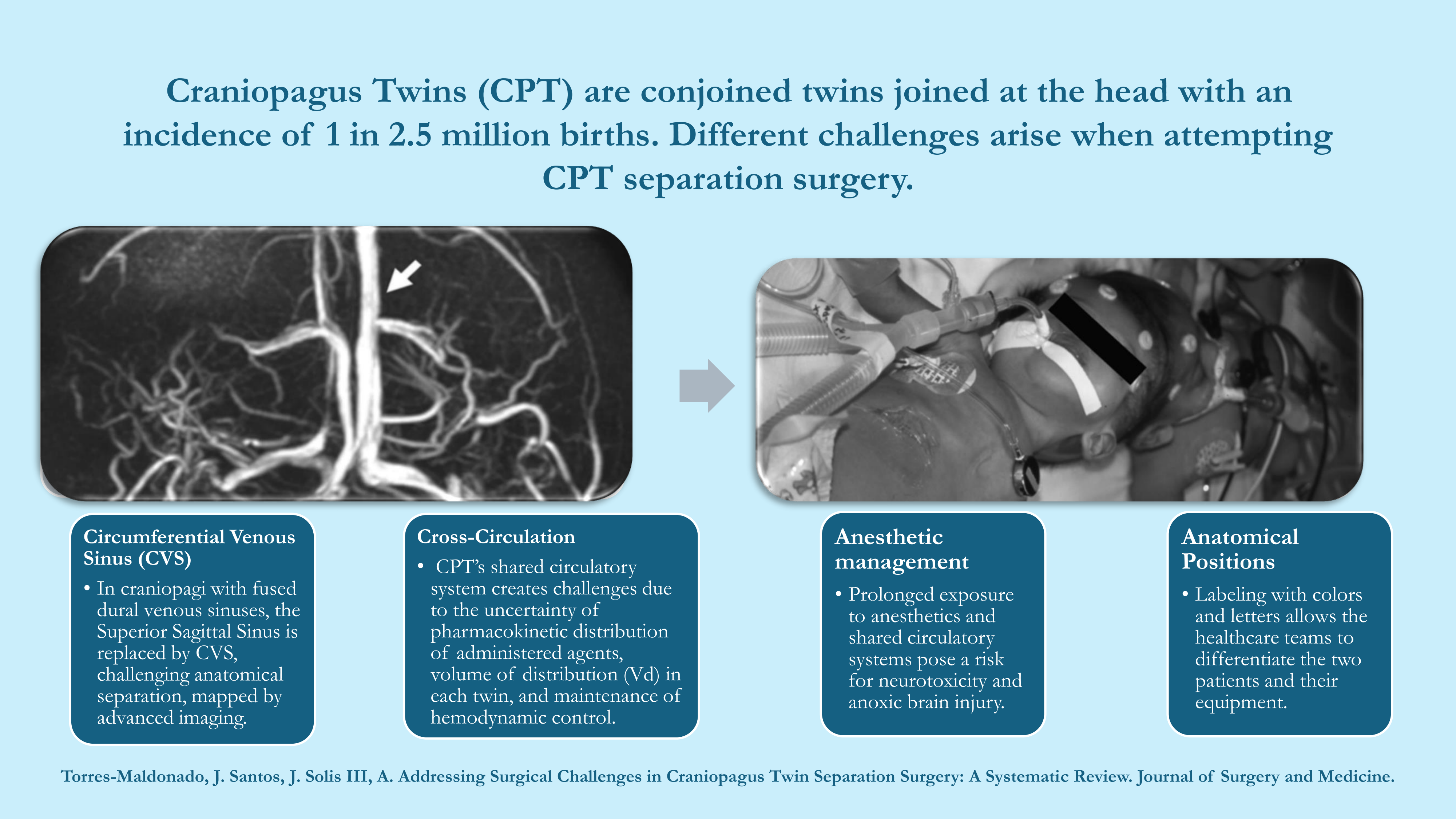
Craniopagus twins (CPTs) are conjoined twins fused at homologous regions of the crania in either vertical or angular orientations, with the face and foramen magnum spared. They account for approximately 6% of conjoined twins and occur in 0.6 per million births worldwide. The degree of circulatory interconnection is a central consideration when planning separation surgery, particularly when deciding between a single-stage and a multistage approach. In craniopagus twins with fused dural venous sinuses, the superior sagittal sinus is replaced by a circumferential venous sinus (CVS); these cases are classified as total CPTs. Surgical challenges become increasingly complex in the presence of a CVS, prolonged anesthetic exposure, substantial cross-circulation, and the unique anatomical position of the twins. This review compiles data on the surgical management of these challenges and their outcomes, contributing to the continued development and refinement of surgical planning in CPT separation surgery. A Google Scholar search restricted to English-language articles published from 2020 to 2024 identified 329 articles. After detailed review, 19 open-access articles were selected for this manuscript. The reviewed literature showed that the degree of cross-circulation can be assessed through laboratory and physiologic measurements after pharmacologic challenges and can be mapped using multiple imaging modalities. The data also showed that a multistage surgical approach is preferentially selected for total CPTs because it reduces the high risks of hemorrhage, ischemic brain injury, and neurotoxicity associated with a CVS and extensively connected circulatory systems. In addition, staged surgery limits anesthetic exposure, decreasing the risk of anesthesia-induced cerebrospinal fluid stasis and hypotension. It also allows cerebral vasculature to redevelop between operations, thereby supporting adequate venous drainage. During surgery, each twin, their equipment, and their care team should be labeled with a number, letter, and color to provide safe and efficient patient care. This literature review maintains the clinical relevance of craniopagus twin separation surgery by presenting an up-to-date summary of methods and protocols designed to ensure surgical precision and safety when unique preoperative and perioperative challenges arise.
Downloads
References
Goldman-Yassen AE, Goodrich JT, Miller TS, Farinhas JM. Preoperative evaluation of craniopagus twins: anatomy, imaging techniques, and surgical management. AJNR Am J Neuroradiol. 2020;41(6):951-9. doi: 10.3174/ajnr.A6571. DOI: https://doi.org/10.3174/ajnr.A6571
Wong TG, Ong BC, Ang C, Chee HL. Anesthetic management for a five-day separation of craniopagus twins. Anesth Analg. 2003;97(4):999-1002. doi: 10.1213/01.ANE.0000078588.36983.08. DOI: https://doi.org/10.1213/01.ANE.0000078588.36983.08
Pontell ME, Salinero LK, Wagner CS, Barrero CE, Tepper OM, Marras CE, et al. Putting our heads together: the future of craniopagus twin separation. J Craniomaxillofac Surg. 2024;52(3):378-84. doi: 10.1016/j.jcms.2024.02.007. DOI: https://doi.org/10.1016/j.jcms.2024.02.007
Lehrich BM, Brown NJ, Shahrestani S, Sahyouni R, Hsu FPK. James T. Goodrich, MD, PhD, 1946-2020: a historical perspective and his contributions to craniopagus separation. J Neurosurg Pediatr. 2020;26(4):454-60. doi: 10.3171/2020.5.PEDS20371. DOI: https://doi.org/10.3171/2020.5.PEDS20371
Gakuba C, Gaberel T, Goursaud S, Bourges J, Di Palma C, Quenault A, et al. General anesthesia inhibits the activity of the “glymphatic system”. Theranostics. 2018;8(3):710-22. doi: 10.7150/thno.19154. DOI: https://doi.org/10.7150/thno.19154
Mohammad SA, AbouZeid AA, Ahmed KA, Abd-Elhamed AM, Rawash Eldieb LM. Postnatal imaging of conjoined twins: a customized multimodality approach. Pediatr Radiol. 2023;53(11):2291-304. doi: 10.1007/s00247-023-05709-3. DOI: https://doi.org/10.1007/s00247-023-05709-3
Pal A, Montero FJ. Conjoined Twins. 2025 Dec 13. In: StatPearls [Internet]. Treasure Island (FL): StatPearls Publishing; 2026 Jan – Available from: https://www.ncbi.nlm.nih.gov/books/NBK560839/
Gupta D, Kedia S, Rath GP, Pandia MP, Chauhan S, Sharma R, et al. A century with craniopagus twin separation surgeries: nihilism to optimism. Neurosurgery. 2022;91(1):27-42. doi: 10.1227/neu.0000000000001962. DOI: https://doi.org/10.1227/neu.0000000000001962
Rawat A, Rai R, Paswan AK, Pandey V. Our experience with anesthetic management of conjoined twins’ separation surgery. Saudi J Anaesth. 2020;14(1):100-3. doi: 10.4103/sja.SJA_142_19. DOI: https://doi.org/10.4103/sja.SJA_142_19
Keunen K, Sperna Weiland NH, de Bakker BS, de Vries LS, Stevens MF. Impact of surgery and anesthesia during early brain development: a perfect storm. Paediatr Anaesth. 2022;32(6):697-705. doi: 10.1111/pan.14433. DOI: https://doi.org/10.1111/pan.14433
Rodman E, Placencia JL. Pharmaceutical considerations with conjoined twins. Semin Perinatol. 2018;42(6):350-4. doi: 10.1053/j.semperi.2018.07.009. DOI: https://doi.org/10.1053/j.semperi.2018.07.009
Sato Y, Iura A, Kawamoto Y, Yamamoto S, Iritakenishi T, Fujino Y. Successful anesthetic management of separation surgery for pygopagus conjoined twins: a case report. JA Clin Rep. 2021;7(1):6. doi: 10.1186/s40981-020-00406-8. DOI: https://doi.org/10.1186/s40981-020-00406-8
Di Rocco C, Caldarelli M, Tamburrini G, Koutzoglou M, Massimi L, Di Rocco F, et al. Craniopagus: the Thessaloniki-Rome experience. Childs Nerv Syst. 2004;20(8-9):576-86. doi: 10.1007/s00381-004-0976-5. DOI: https://doi.org/10.1007/s00381-004-0976-5
Lasjaunias P, Kwok R, Goh P, Yeong KY, Lim W, Chng SM. A developmental theory of the superior sagittal sinus(es) in craniopagus twins. Childs Nerv Syst. 2004;20(8-9):526-37. doi: 10.1007/s00381-004-1007-2. DOI: https://doi.org/10.1007/s00381-004-1007-2
Stone JL, Goodrich JT. The craniopagus malformation: classification and implications for surgical separation. Brain. 2006;129(Pt 5):1084-95. doi: 10.1093/brain/awl065. DOI: https://doi.org/10.1093/brain/awl065
Bateman GA, Siddique SH. Cerebrospinal fluid absorption block at the vertex in chronic hydrocephalus: obstructed arachnoid granulations or elevated venous pressure? Fluids Barriers CNS. 2014;11:11. doi: 10.1186/2045-8118-11-11. DOI: https://doi.org/10.1186/2045-8118-11-11
Yadav M, Chikkala R, Kulkarni D, Gopinath R. Anesthetic management of craniopagus conjoined twins in a remote location. Saudi J Anaesth. 2017;11(4):516-7. doi: 10.4103/sja.SJA_288_17. DOI: https://doi.org/10.4103/sja.SJA_288_17
Antônio F, Cifuentes S, Delgado M, Damasceno C, Torres M, Jorge V, et al. Anesthetic management of an omphalopagus conjoined twins separation surgery: a case report. Case Rep Rev Open Access. 2021;2(2):125-6. Available from: https://gnoscience.com/.
Kaur M, Sinha R, Chowdhury AR, Sharma S, Nagarajan B, Baishya M, et al. Preoperative planning for central venous cannulation in conjoint twins. J Anaesthesiol Clin Pharmacol. 2020;36(4):569-70. doi: 10.4103/joacp.JOACP_596_20. DOI: https://doi.org/10.4103/joacp.JOACP_596_20
Giwangkancana G, Kusmayadi DD, Kadi F, Utariani A, Haryawan Z. The multidisciplinary perioperative management of conjoined twin separation surgery during the pandemic. J Multidiscip Healthc. 2022;15:2669-78. doi: 10.2147/JMDH.S390419. DOI: https://doi.org/10.2147/JMDH.S390419
Downloads
- 367 283
Published
Issue
Section
How to Cite
License
Copyright (c) 2026 Juliet Torres-maldonado, Javier Santos González, Armin Solis Iii

This work is licensed under a Creative Commons Attribution-NonCommercial-NoDerivatives 4.0 International License.
Citations