Bilateral extensor medii proprius: A cadaveric case report
Bilateral extensor medii proprius
Authors
-
Michael Christian
Rocky Vista University
 https://orcid.org/0009-0000-6186-496X
-
Erica Noe
Oms I, Rocky Vista University College of Osteopathic Medicine, Ivins, Utah, United States
https://orcid.org/0009-0005-2752-6621
-
Dhruti Patel
Rocky Vista University
https://orcid.org/0009-0003-8196-9437
-
Imran Qayum
Rocky Vista University
https://orcid.org/0009-0005-9462-2867
-
James Turney
Rocky Vista University
https://orcid.org/0009-0005-9428-3543
-
Amberly Reynolds
Rocky Vista University
https://orcid.org/0000-0002-8559-9328

Keywords:
extensor medii proprius, extensor indicis, forearm anatomical variation, embryology, cadaveric dissectionAbstract
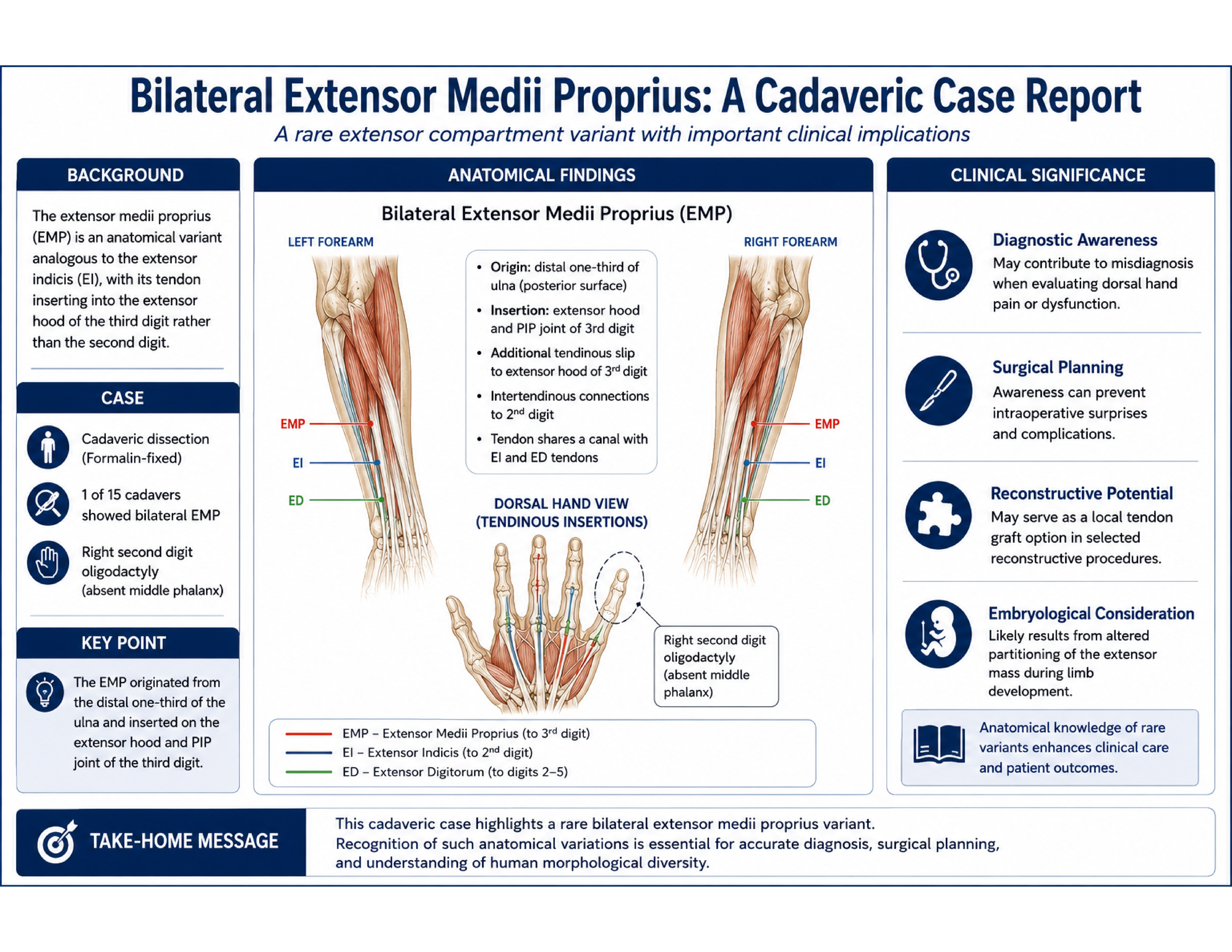
During dissection of a formalin-fixed cadaver in the upper-limb unit of a gross anatomy laboratory, bilateral anomalous muscle bellies and tendons, identified as the extensor medii proprius (EMP), were observed in the posterior compartments of the forearms. The muscle originated from the distal one-third of the ulna and inserted on the extensor hood and proximal interphalangeal joint of the third digit, with an additional tendinous slip connecting to the extensor hood of the third digit and intertendinous connections to the second digit. Both tendons shared a canal with the extensor indicis (EI) and extensor digitorum (ED) tendons. The EMP was distinguished from the EI and ED by its insertion on the third digit and by a separate muscle belly, unlike the ED, which has a common origin and multiple tendons to digits two through five, and the EI, which inserts on the second digit. Although anomalies of the extensor forearm muscles are not uncommon, the literature documenting these variants remains limited. Recognition of these variants is clinically relevant because they can contribute to misdiagnosis when evaluating dorsal hand pain, affect surgical planning, or provide potential graft sources during reconstructive procedures. This report describes the bilateral EMP variant and discusses its prevalence, clinical significance, and possible embryological origin.
Downloads
References
Baker C, Swartz G, Garcia J, Hernandez Perez F, McIntosh LP. Extensor medii proprius: a cadaveric case report. Cureus. 2023;15(9):e46018. doi: 10.7759/cureus.46018. DOI: https://doi.org/10.7759/cureus.46018
Paraskevas G, Natsis K, Ioannidis O, Papaziogas B, Kitsoulis P, Spanidou S. Accessory muscles in the lower part of the anterior compartment of the arm that may entrap neurovascular elements. Clin Anat. 2008;21(3):246-51. doi: 10.1002/ca.20608. DOI: https://doi.org/10.1002/ca.20608
Yammine K. The prevalence of the extensor indicis tendon and its variants: a systematic review and meta-analysis. Surg Radiol Anat. 2015;37(3):247-54. doi: 10.1007/s00276-014-1352-0. DOI: https://doi.org/10.1007/s00276-014-1352-0
Buckingham M, Bajard L, Chang T, Daubas P, Hadchouel J, Meilhac S, et al. The formation of skeletal muscle: from somite to limb. J Anat. 2003;202(1):59-68. doi: 10.1046/j.1469-7580.2003.00139.x. DOI: https://doi.org/10.1046/j.1469-7580.2003.00139.x
Wilde S, Feneck EM, Mohun TJ, Logan MPO. 4D formation of human embryonic forelimb musculature. Development. 2021;148(4):dev194746. doi: 10.1242/dev.194746. DOI: https://doi.org/10.1242/dev.194746
Gabríková K, Kachlík D, Belbl M, Kunc V. An accessory muscle belly or an accessory muscle head? An unusual arrangement of muscles in the anterior compartment of the forearm. Surg Radiol Anat. 2023;45(3):271-5. doi: 10.1007/s00276-023-03084-0. DOI: https://doi.org/10.1007/s00276-023-03084-0
Tan ST, Smith PJ. Anomalous extensor muscles of the hand: a review. J Hand Surg Am. 1999;24(3):449-55. doi: 10.1053/jhsu.1999.0449. DOI: https://doi.org/10.1053/jhsu.1999.0449
von Schroeder HP, Botte MJ. The extensor medii proprius and anomalous extensor tendons to the long finger. J Hand Surg Am. 1991;16(6):1141-5. doi: 10.1016/s0363-5023(10)80081-4. DOI: https://doi.org/10.1016/S0363-5023(10)80081-4
Kumka M. A variant extensor indicis muscle and the branching pattern of the deep radial nerve could explain hand functionality and clinical symptoms in the living patient. J Can Chiropr Assoc. 2015;59(1):64-71.
Khazzam M, Patillo D, Gainor BJ. Extensor tendon triggering by impingement on the extensor retinaculum: a report of 5 cases. J Hand Surg Am. 2008;33(8):1397-400. doi: 10.1016/j.jhsa.2008.04.007. DOI: https://doi.org/10.1016/j.jhsa.2008.04.007
Yaşar YK, Anıl A, Anıl F, Kastamoni M, Peker TV. Anatomic variations of the hand extensor muscle tendons. Gazi Med J. 2017;28(3):206-7. doi: 10.12996/gmj.2017.60. DOI: https://doi.org/10.12996/gmj.2017.60
Downloads
- 126 86
Published
Issue
Section
How to Cite
License
Copyright (c) 2026 Michael Christian, Erica Noe, Dhruti Patel, Imran Qayum, James Turney, Amberly Reynolds

This work is licensed under a Creative Commons Attribution-NonCommercial-NoDerivatives 4.0 International License.
Citations