Popliteal artery rupture with closed degloving injury: A case report
Popliteal artery rupture with closed degloving injury
Authors
-
Gede Ridho Anandya Prasetya
Faculty of Medicine, Universitas Islam Sultan Agung, Semarang, Indonesia
 https://orcid.org/0009-0003-9624-7867
-
Muhammad Ali Shodiq
Department of Surgery, Faculty of Medicine, Universitas Islam Sultan Agung, Semarang, Indonesia
https://orcid.org/0009-0006-1880-5474

Keywords:
closed deglove, popliteal artery rupture, Morel-Lavallée lesion, arteriography, irreversible ischemia, amputationAbstract
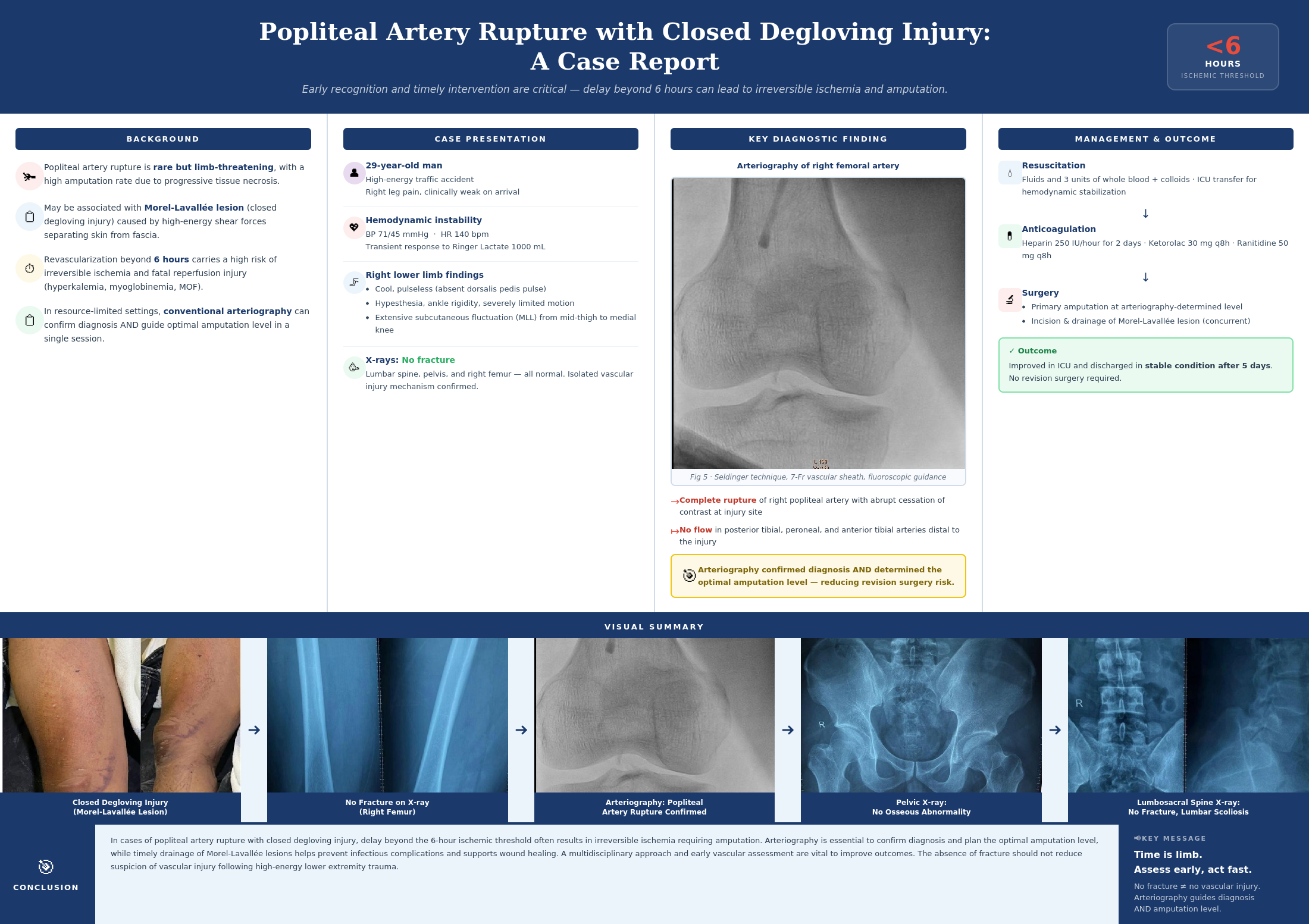
Popliteal artery rupture is a rare but limb-threatening vascular injury, particularly when it occurs with a Morel-Lavallée lesion (closed degloving injury). The concurrent presence of complete arterial disruption and extensive soft-tissue damage substantially increases the risk of irreversible distal ischemia and amputation, especially when definitive intervention is delayed beyond the critical six-hour ischemic threshold. We report the case of a 29-year-old man who presented after a high-energy traffic accident with hemodynamic instability, absent distal arterial pulsation, and extensive subcutaneous fluctuation extending from the right thigh to the medial knee. Initial radiologic assessment revealed no fracture. Arteriography of the right femoral artery confirmed complete rupture of the right popliteal artery with nonvisualization of the posterior tibial, peroneal, and distal anterior tibial arteries beyond the injury site. Arteriographic delineation of the vascular occlusion level was used to determine the optimal amputation level. The patient underwent fluid resuscitation, transfusion of three units of whole blood, intravenous heparin therapy, surgical drainage of the closed degloving cavity, and primary amputation of the right lower extremity. Amputation was required because delayed presentation beyond the golden period had resulted in irreversible ischemia. He was discharged in stable condition after five days of hospitalization. This case underscores the need for early recognition and timely intervention in popliteal artery injuries. Delay beyond the ischemic threshold substantially increases the risk of amputation. A multidisciplinary approach and awareness of the narrow window for limb salvage are essential in complex lower extremity trauma.
Downloads
References
Tomaszewski KA, Popieluszko P, Graves MJ, Pekala PA, Henry BM, Roy J, et al. The evidence-based surgical anatomy of the popliteal artery and the variations in its branching patterns. J Vasc Surg. 2017;65(2):521-9.e6. DOI: https://doi.org/10.1016/j.jvs.2016.01.043
Drake RL, Vogl W, Mitchell AWM. Gray's Basic Anatomy. International ed. Philadelphia: Elsevier Churchill Livingstone; 2017. p. 293.
Liu J, Li J, Jiang P, Jia W, Tian X, Cheng Z, et al. Literature review of peripheral vascular trauma: is the era of intervention coming? Chin J Traumatol. 2020;23(1):5-9. DOI: https://doi.org/10.1016/j.cjtee.2019.11.003
Vanhegan IS, Verhelst L, Mallucci P, Haddad FS. The Morel-Lavallee lesion as a rare differential diagnosis for recalcitrant bursitis of the knee: case report and literature review. J Orthop Surg Res. 2012;7(1):36. DOI: https://doi.org/10.1155/2012/593193
Sciarretta JD, Macedo FIB, Otero CA, Figueroa JN, Pizano LR, Namias N. Management of traumatic popliteal vascular injuries in a level I trauma center: a 6-year experience. Int J Surg. 2015;18:136-41. DOI: https://doi.org/10.1016/j.ijsu.2015.04.056
Burkhardt GE, Gifford SM, Propper B, Spencer JR, Williams K, Jones L, et al. The impact of ischemic intervals on neuromuscular recovery in a porcine (Sus scrofa) survival model of extremity vascular injury. J Vasc Surg. 2011;53(1):165-73. DOI: https://doi.org/10.1016/j.jvs.2010.07.012
Grigorian A, Wilson SE, Kabutey NK, Fujitani RM, de Virgilio C, Schubl SD, et al. Decreased national rate of below-the-knee amputation in patients with popliteal artery injury. Ann Vasc Surg. 2019;57:1-9. DOI: https://doi.org/10.1016/j.avsg.2018.07.002
Hudson DA, Knottenbelt JD, Krige JEJ. Closed degloving injuries: results following conservative surgery. Plast Reconstr Surg. 1992;89(5):853-5. DOI: https://doi.org/10.1097/00006534-199205000-00013
Agrawal U, Tiwari V. Morel Lavallee lesion. In: StatPearls [Internet]. Treasure Island (FL): StatPearls Publishing; 2023 [cited 2025 Nov 22]. Available from: https://www.ncbi.nlm.nih.gov/books/NBK574532/
Wahhab J, Zwijack A. Beware the ides of Morel-Lavallee: a lesion to consider when diagnosing trauma patients. Trauma Case Rep. 2023;47:100917. DOI: https://doi.org/10.1016/j.tcr.2023.100917
Huang D, Killian M, Elbadri S, Leon L, Ganti L. Morel-Lavallee lesion of the distal thigh: emergency department diagnosis with point-of-care ultrasound. Radiol Case Rep. 2023;18(6):2136-9. DOI: https://doi.org/10.1016/j.radcr.2023.03.004
Olinic DM, Stanek A, Tataru DA, Homorodean C. Acute limb ischemia: an update on diagnosis and management. J Clin Med. 2019;8(8):1215. DOI: https://doi.org/10.3390/jcm8081215
Gu YQ. Determination of amputation level in ischaemic lower limbs. ANZ J Surg. 2004;74(2):31-3. DOI: https://doi.org/10.1046/j.1445-1433.2003.02787.x
van Rensburg K, Steyn W, Cassimjee I, Stephens M. Outcomes of popliteal artery injuries in a level 1 trauma centre: a 6-year review. Eur J Trauma Emerg Surg. 2025;51(1):63. DOI: https://doi.org/10.1007/s00068-024-02691-9
Kim TI, Mena C, Sumpio BE. The role of lower extremity amputation in chronic limb-threatening ischemia. Int J Angiol. 2020;29:149-55. DOI: https://doi.org/10.1055/s-0040-1710075
Mitsuzawa S, Yamashita S, Tsukamoto Y, Takeuchi H, Ota S. What is the optimal treatment protocol for traumatic popliteal artery injury? A comparative study between two institutions. J Emerg Trauma Shock. 2024;17(3):134-40. DOI: https://doi.org/10.4103/jets.jets_164_23
Tamburrini S, Lassandro G, Tiralongo F, Iacobellis F, Ronza FM, Liguori C, et al. CTA imaging of peripheral arterial injuries. Diagnostics (Basel). 2024;14(13):1430. DOI: https://doi.org/10.3390/diagnostics14131356
Cooper N, Roshdy M, Sciarretta JD, Kaufmann C, Duncan S, Davis J, et al. Multidisciplinary team approach in the management of popliteal artery injury. J Multidiscip Healthc. 2018;11:399-403. DOI: https://doi.org/10.2147/JMDH.S151498
McGowan SP, Fallahi AKM. Degloving injuries. In: StatPearls [Internet]. Treasure Island (FL): StatPearls Publishing; 2023. Available from: https://www.ncbi.nlm.nih.gov/books/NBK557707/
Diviti S, Gupta N, Hooda K, Sharma K, Lo L. Morel-Lavallee lesions: review of pathophysiology, clinical findings, imaging findings and management. J Clin Diagn Res. 2017;11(4):TE01-4. DOI: https://doi.org/10.7860/JCDR/2017/25479.9689
Shen C, Chen J, Peng X. Efficacy of treatment in peri-pelvic Morel-Lavallee lesion: a systematic review of the literature. Arch Orthop Trauma Surg. 2013;133(5):635-40. DOI: https://doi.org/10.1007/s00402-013-1703-z
Nickerson TP, Zielinski MD, Jenkins DH, Schiller HJ. The Mayo Clinic experience with Morel-Lavallee lesions: establishment of a practice management guideline. J Trauma Acute Care Surg. 2014;76(2):493-7. DOI: https://doi.org/10.1097/TA.0000000000000111
Downloads
- 644 694
Published
Issue
Section
How to Cite
License
Copyright (c) 2026 Gede Ridho Anandya Prasetya, Muhammad Ali Shodiq

This work is licensed under a Creative Commons Attribution-NonCommercial-NoDerivatives 4.0 International License.
Citations