Optimizing common bile duct stone management: Single-stage laparoscopic exploration versus two-stage ERCP and cholecystectomy
Single-stage versus two-stage CBD stone management
Authors
-
Mohamed Sayed
Department of General Surgery, Sohag University, Sohag, Egypt
 https://orcid.org/0009-0004-1520-1451
-
Abdullah Abdullah
Department of General Surgery, Faculty of Medicine, Luxor University, Luxor, Egypt
https://orcid.org/0000-0002-8433-3966
-
Mostafa Saleem
Department of General Surgery, Faculty of Medicine, Luxor University, Luxor, Egypt
https://orcid.org/0000-0003-3170-402X
-
Nehal Mahmoud
Department of Medical Biochemistry, Faculty of Medicine, Qena University, Qena, Egypt
https://orcid.org/0000-0002-4917-1834

Keywords:
common bile duct stones, gallstones, laparoscopic cholecystectomy, endoscopic retrograde cholangiopancreatography, single-stage surgery, patient outcomesAbstract
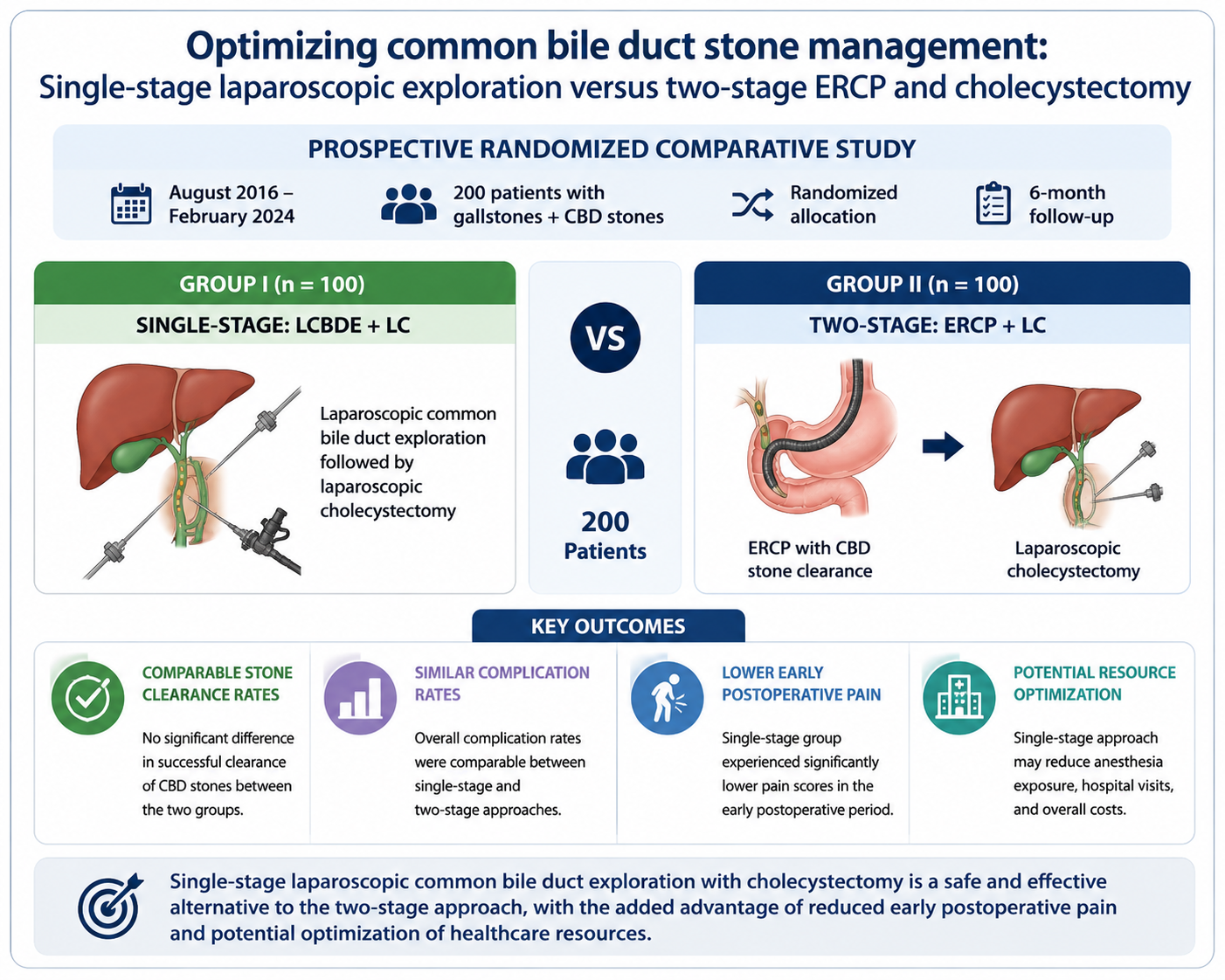
Background/Aim: Concomitant gallbladder and common bile duct (CBD) stones can be managed with a single-stage operative pathway, including laparoscopic CBD exploration (LCBDE) and laparoscopic cholecystectomy (LC), or with a two-stage strategy using preoperative endoscopic retrograde cholangiopancreatography (ERCP) followed by LC during the same admission. In this randomized controlled trial, we compared these strategies in terms of perioperative safety, overall effectiveness, and patient recovery experience.
Methods: A total of 200 patients with gallstones and CBD stones were enrolled between January 2016 and December 2024 and randomized using sealed opaque envelopes to Group I, single-stage LCBDE + LC (n = 100), or Group II, two-stage ERCP + LC (n = 100). The primary outcome was successful CBD stone clearance and gallbladder removal using the assigned approach without conversion. Secondary outcomes included postoperative pain, complications, hospital stay, retained CBD stones, and patient satisfaction. Data were analyzed using SPSS version 26, and statistical significance was defined as a two-tailed P-value <0.050.
Results: Baseline demographic characteristics were similar between groups. Mean CBD diameter and stone size were larger in Group I than in Group II [13.18 (2.01) mm vs. 10.94 (2.46) mm, P <0.001; and 6.29 (1.47) mm vs. 5.65 (1.69) mm, P = 0.005, respectively]. Mean operative time was comparable [138.3 (20.4) min vs. 140.85 (43.98) min, P = 0.600]. Intraoperative complication and conversion rates were low and comparable. Postoperative direct bilirubin levels were slightly higher in Group I [1.01 (0.08) mg/dL vs. 0.83 (0.06) mg/dL, P = 0.030]. Early pain scores at 24 h favored Group I [5.34 (1.02) vs. 6.30 (1.02), P <0.001], whereas day 3 pain scores were similar. Retained CBD stones were rare [3% vs. 0%, P = 0.246]. Hospital stay, overall complications, and patient satisfaction were comparable between groups.
Conclusion: Single-stage LCBDE + LC was as safe and effective as two-stage ERCP + LC and was associated with better early pain control and potential resource advantages through single-session treatment. Both strategies remain viable options, and the preferred approach should be guided by patient anatomy, local expertise, available resources, and institutional logistics.
Downloads
References
Dasari BV, Tan CJ, Gurusamy KS, Martin DJ, Kirk G, McKie L, et al. Surgical versus endoscopic treatment of bile duct stones. Cochrane Database Syst Rev. 2013;2013(12):CD003327. doi: 10.1002/14651858.CD003327.pub3. DOI: https://doi.org/10.1002/14651858.CD003327.pub3
Rogers SJ, Cello JP, Horn JK, Siperstein AE, Schecter WP, Campbell AR, et al. Prospective randomized trial of laparoscopic cholecystectomy plus laparoscopic common bile duct exploration versus ERCP/sphincterotomy plus laparoscopic cholecystectomy for common bile duct stone disease. Arch Surg. 2010;145(1):28-33. doi: 10.1001/archsurg.2009.226. DOI: https://doi.org/10.1001/archsurg.2009.226
Bansal VK, Misra MC, Rajan K, Kilambi R, Kumar S, Krishna A, et al. Single-stage laparoscopic common bile duct exploration and cholecystectomy versus two-stage endoscopic stone extraction followed by laparoscopic cholecystectomy: a randomized controlled trial. Surg Endosc. 2014;28(3):875-85. doi: 10.1007/s00464-013-3237-4. DOI: https://doi.org/10.1007/s00464-013-3237-4
Koc B, Karahan S, Adas G, Tutal F, Guven H, Ozsoy A. Comparison of laparoscopic common bile duct exploration and ERCP plus laparoscopic cholecystectomy for choledocholithiasis: a prospective randomized study. Am J Surg. 2013;206(4):457-63. doi: 10.1016/j.amjsurg.2013.02.004. DOI: https://doi.org/10.1016/j.amjsurg.2013.02.004
Singh AN, Kilambi R. Single-stage laparoscopic common bile duct exploration and cholecystectomy versus two-stage endoscopic stone extraction followed by laparoscopic cholecystectomy: systematic review and meta-analysis of randomized trials. Surg Endosc. 2018;32(9):3763-76. doi: 10.1007/s00464-018-6170-8.
Lyu Y, Cheng Y, Li T, Cheng B, Jin X. Laparoscopic common bile duct exploration plus cholecystectomy versus preoperative ERCP plus laparoscopic cholecystectomy for cholecystocholedocholithiasis: a meta-analysis. Surg Endosc. 2019;33(10):3275-86. doi: 10.1007/s00464-018-06613-w. DOI: https://doi.org/10.1007/s00464-018-06613-w
Li ZQ, Sun JX, Li B, Dai XQ, Yu AX, Li ZF. Meta-analysis of single-stage versus two-stage management for concomitant gallstones and common bile duct stones. Medicine (Baltimore). 2020;99(31):e21042. doi: 10.1097/MD.0000000000021042. DOI: https://doi.org/10.4103/jmas.JMAS_146_18
Zhu J, Li G, Du P, Zhou X, Xiao W, Li Y. Laparoscopic common bile duct exploration versus intraoperative ERCP plus laparoscopic cholecystectomy: a meta-analysis. Surg Endosc. 2021;35(3):997-1005. doi: 10.1007/s00464-020-08052-y. DOI: https://doi.org/10.1007/s00464-020-08052-y
Nie S, Fu S, Fang K. Comparison of one-stage treatment versus two-stage treatment for management of patients with common bile duct stones: a meta-analysis. Front Surg. 2023;10:1124955. doi: 10.3389/fsurg.2023.1124955. DOI: https://doi.org/10.3389/fsurg.2023.1124955
Franklin ME Jr. Laparoscopic common bile duct exploration. Arch Surg. 1994;129(5):499-503. doi: 10.1001/archsurg.1994.01420170103019.
Sahoo MR, Kumar AT, Patnaik A. Randomized comparison: laparo-endoscopic rendezvous versus two-stage ERCP + LC for cholelithiasis with choledocholithiasis. J Minim Access Surg. 2014;10(3):139-43. doi: 10.4103/0972-9941.134877. DOI: https://doi.org/10.4103/0972-9941.134877
Reinders JS, Gouma DJ, Ubbink DT, van Ramshorst B, Boerma D. Transcystic or transductal extraction during single-stage treatment of choledocholithiasis: a systematic review. World J Surg. 2014;38(10):2403-11. doi: 10.1007/s00268-014-2537-8. DOI: https://doi.org/10.1007/s00268-014-2537-8
Waage A, Nilsson M. Long-term results from laparoscopic common bile duct exploration. Surg Endosc. 2003;17(3):475-9. doi: 10.1007/s00464-002-8937-0. DOI: https://doi.org/10.1007/s00464-002-8937-0
Petelin JB. Laparoscopic common bile duct exploration. Surg Endosc. 2003;17(11):1705-15. doi: 10.1007/s00464-003-9094-0. DOI: https://doi.org/10.1007/s00464-002-8917-4
Lu J, Cheng Y, Xiong XZ, Lin YX, Wu SJ, Cheng NS. Two-stage versus single-stage management for concomitant gallstones and common bile duct stones: a meta-analysis. J Gastrointest Surg. 2015;19(5):848-57. doi: 10.1007/s11605-014-2709-3.
Kelly T, Vance J, Khan M, Naylor G, Patil P. Laparoscopic transcystic common bile duct exploration: outcomes and learning curve. Surg Laparosc Endosc Percutan Tech. 2018;28(5):345-51. doi: 10.1097/SLE.0000000000000561. DOI: https://doi.org/10.1097/SLE.0000000000000561
Alexakis N, Connor S. Meta-analysis of one-stage versus two-stage laparoscopic/endoscopic management of common bile duct stones. HPB (Oxford). 2012;14(4):254-9. doi: 10.1111/j.1477-2574.2012.00439.x. DOI: https://doi.org/10.1111/j.1477-2574.2012.00439.x
ElGeidie A, El-Hemaly M, Abd-Elsayed A, Atef E, Shehta A. LCBDE versus ERCP + LC: a comparative study reporting clearance rates and complications. Surg Endosc. 2016;30(2):582-8. doi: 10.1007/s00464-015-4255-y.
Society of American Gastrointestinal and Endoscopic Surgeons (SAGES). Clinical Spotlight Review: Laparoscopic Common Bile Duct Exploration. Los Angeles (CA): Society of American Gastrointestinal and Endoscopic Surgeons; 2017.
Singh AN, Kilambi R. Single-stage laparoscopic common bile duct exploration and cholecystectomy versus two-stage endoscopic stone extraction followed by laparoscopic cholecystectomy: systematic review and meta-analysis of randomized trials. Surg Endosc. 2018;32(9):3763-76. doi:10.1007/s00464-018-6170-8. DOI: https://doi.org/10.1007/s00464-018-6170-8
Downloads
- 364 405
Published
Issue
Section
How to Cite
License
Copyright (c) 2026 Mohamed Sayed, Abdullah Abdullah, Mostafa Saleem, Nehal Mahmoud

This work is licensed under a Creative Commons Attribution-NonCommercial-NoDerivatives 4.0 International License.
Citations