Six months silent: A rare case of delayed duodenal perforation and pancreatitis following intentional foreign body ingestion
Delayed duodenal perforation and pancreatitis following foreign body ingestion
Authors
-
Noor Riaz
Department of General Surgery, Larkin Community Hospital, FL, United States
 https://orcid.org/0009-0004-9390-3467
-
Johanna Rosa
Department of General Surgery, Larkin Community Hospital, FL, United States
https://orcid.org/0009-0005-2966-2790
-
Hamda Soubagle
Department of General Surgery, Larkin Community Hospital, FL, United States
https://orcid.org/0009-0009-5856-7759
-
Necial Marcelin
Department of General Surgery, Larkin Community Hospital, FL, United States
https://orcid.org/0009-0003-2680-0014
-
Mohammad Masri
Department of General Surgery, Larkin Community Hospital, FL, United States
https://orcid.org/0009-0006-0271-5802

Keywords:
Foreign body ingestion, Duodenal perforation, Enterocutaneous fistula, Pancreatitis, Pyloric exclusion, Case report, Psychiatric comorbidityAbstract
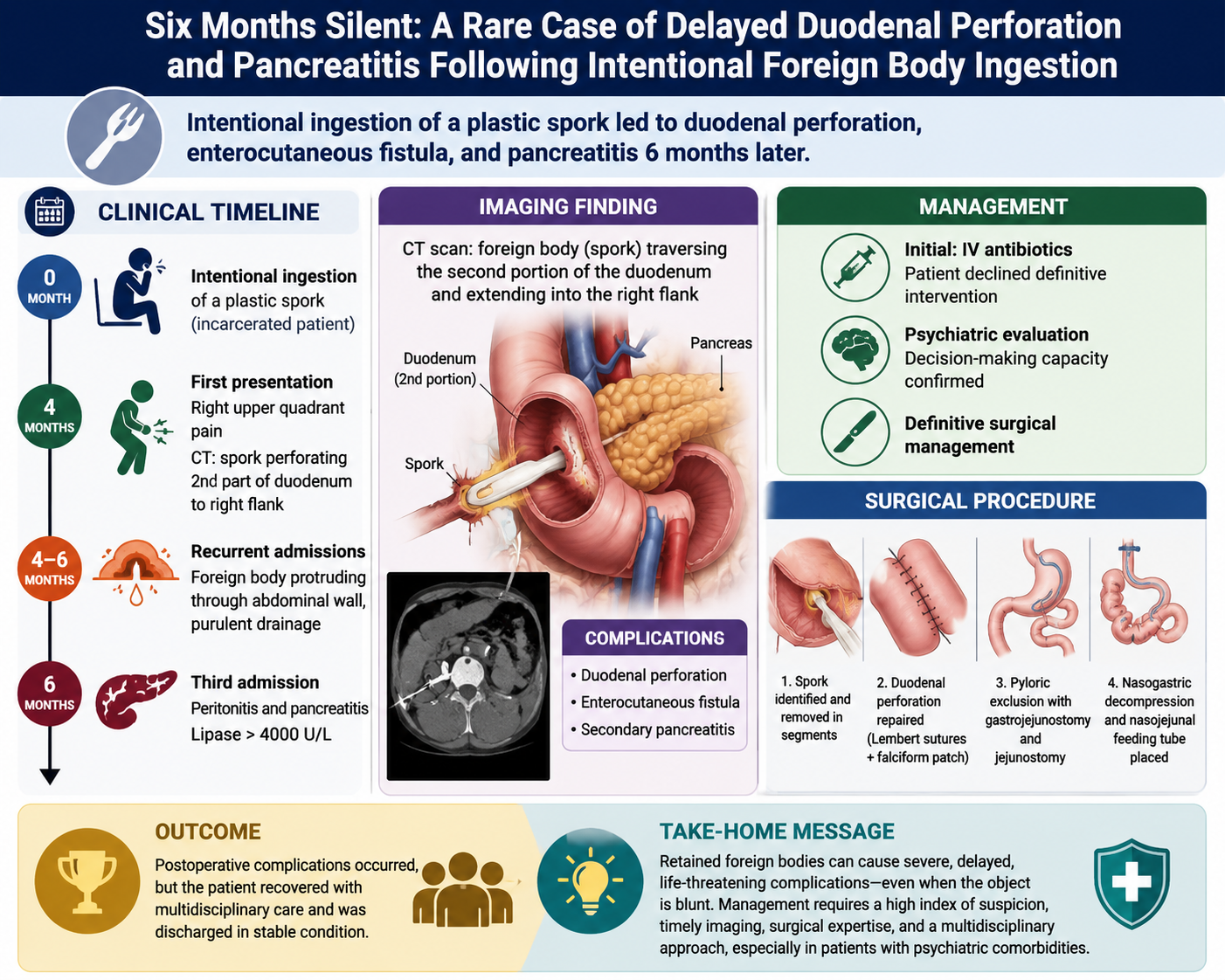
Foreign body ingestion is usually self-limited, with most objects passing spontaneously without complications. Rarely, however, retained foreign bodies may cause severe and delayed sequelae. We report the case of a 56-year-old incarcerated man who developed duodenal perforation, an enterocutaneous fistula, and secondary pancreatitis six months after intentional ingestion of a plastic spork. Imaging demonstrated a foreign body penetrating the second portion of the duodenum and extending into the abdominal wall. Definitive surgical management was delayed because of psychiatric illness and repeated refusal of care. After eventual consent was obtained, the patient underwent exploratory laparotomy with foreign body removal, duodenal repair, pyloric exclusion, and gastrointestinal diversion. Despite postoperative complications, he recovered with multidisciplinary management. This case highlights the potential for delayed, life-threatening complications from retained foreign bodies and underscores the ethical and clinical challenges encountered in patients with psychiatric comorbidities.
Downloads
References
Ma LY, Liu ZQ, Wang Y, Wang T, Sun GB, Wang L, et al. Endoscopic management of duodenal perforation caused by foreign bodies in adults: a retrospective study. United European Gastroenterol J. 2024;12(3):390-8. doi: 10.1002/ueg2.12505. DOI: https://doi.org/10.1002/ueg2.12505
Velitchkov NG, Grigorov GI, Losanoff JE, Kjossev KT. Ingested foreign bodies of the gastrointestinal tract: retrospective analysis of 542 cases. World J Surg. 1996;20(8):1001-5. doi: 10.1007/s002689900152. DOI: https://doi.org/10.1007/s002689900152
Wang Q, Cheng S, Zhang X, Xie T, Sun X, Niu Z, et al. An asymptomatic perforation of the gastrointestinal tract caused by ingestion of foreign body: a case report. Clin Case Rep. 2024;12(2):e8142. doi: 10.1002/ccr3.8142. DOI: https://doi.org/10.1002/ccr3.8142
Yu M, Li K, Zhou S, Wang H, Le M, Li C, et al. Endoscopic removal of sharp-pointed foreign bodies with both sides embedded into the duodenal wall in adults: a retrospective cohort study. Int J Gen Med. 2021;14:9361-9. doi: 10.2147/IJGM.S338643. DOI: https://doi.org/10.2147/IJGM.S338643
Mejri A, Yaacoubi J, Mseddi MA, Omry A. Gastrointestinal perforations by ingested foreign bodies: a preoperative diagnostic flowchart-based experience. A case series report. Int J Surg Case Rep. 2022;95:107216. doi: 10.1016/j.ijscr.2022.107216. DOI: https://doi.org/10.1016/j.ijscr.2022.107216
Yoo DR, Im CB, Jun BG, Seo HI, Park JK, Lee SJ, et al. Clinical outcomes of endoscopic removal of foreign bodies from the upper gastrointestinal tract. BMC Gastroenterol. 2021;21(1):385. doi: 10.1186/s12876-021-01959-3. DOI: https://doi.org/10.1186/s12876-021-01959-3
Yu S, Su S, Shao X, Zhou Y, Yu Y, Kuai X, et al. Misdiagnosis of acute pancreatitis in a patient with foreign body ingestion: a case report and literature review. Am J Transl Res. 2022;14(11):8286-91.
Hang D, Ding K, Tang J, Ning B, Feng L. Acute pancreatitis caused by fishbone impaction in the pancreas: a case report. Cureus. 2025;17(8):e89327. doi: 10.7759/cureus.89327. DOI: https://doi.org/10.7759/cureus.89327
Amaral AC, Hussain WK, Han S. Looking for a needle in a haystack. Gastroenterology. 2023;164(7):1066-8. doi: 10.1053/j.gastro.2023.02.003. DOI: https://doi.org/10.1053/j.gastro.2023.02.003
Downloads
- 253 430
Published
Issue
Section
How to Cite
License
Copyright (c) 2026 Noor Riaz, Johanna Rosa, Hamda Soubagle, Necial Marcelin, Mohammad Masri

This work is licensed under a Creative Commons Attribution-NonCommercial-NoDerivatives 4.0 International License.
Citations