Hyperbilirubinemia and elevated C-reactive protein as predictive markers for appendiceal perforation in acute appendicitis: A prospective observational study
Predictive markers for appendiceal perforation in acute appendicitis
Authors
-
Sai Trinadh Gunda
Department of General Surgery, Fortis Hospital, Mulund, Mumbai, Maharashtra, India
 https://orcid.org/0009-0004-8892-2444
-
Arulvanan Nandan
Department of General Surgery, Fortis Hospital, Mulund, Mumbai, Maharashtra, India
https://orcid.org/0009-0008-2107-1082

Keywords:
Hyperbilirubinemia, C-Reactive Protein, Predictive Biomarkers, appendicitis, appendicular perforationAbstract
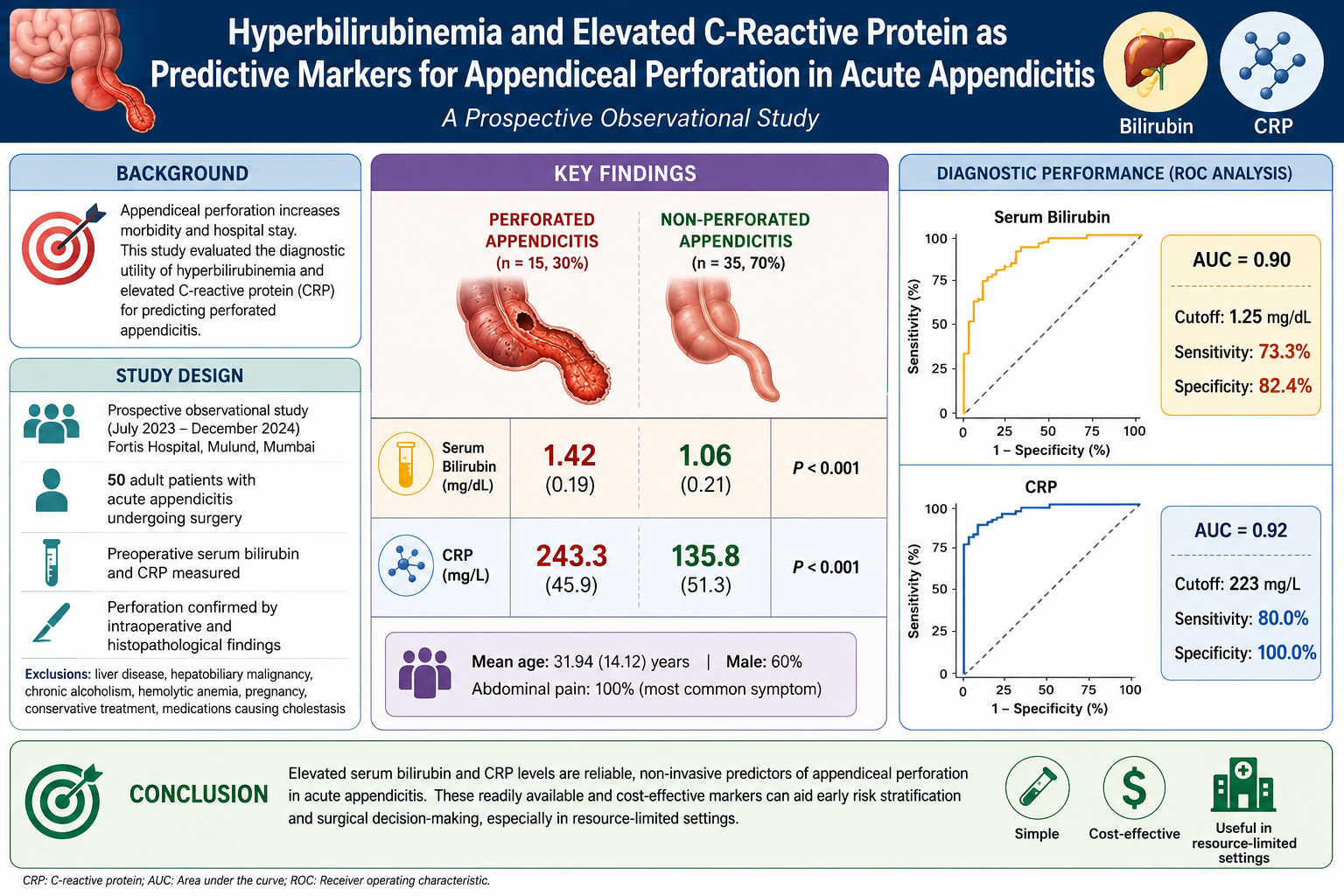
Background/Aim: Appendiceal perforation is a serious complication of acute appendicitis and contributes substantially to postoperative morbidity and prolonged hospital stay. Although imaging supports diagnosis, access may be limited in resource-constrained settings. This study evaluated the diagnostic utility of hyperbilirubinemia and elevated C-reactive protein (CRP) as cost-effective and readily available biomarkers for predicting appendiceal perforation.
Methods: This prospective observational study was conducted at Fortis Hospital, Mulund, Mumbai, from July 2023 to December 2024. Fifty adult patients with acute appendicitis who provided informed consent and underwent surgical management were included. Patients with liver disease, hepatobiliary malignancy, chronic alcoholism, hemolytic anemia, pregnancy, conservative treatment, or medications causing cholestasis were excluded. Preoperative serum bilirubin and CRP levels were measured and correlated with intraoperative and histopathological findings.
Results: The mean age of the 50 enrolled patients was 31.94 (14.12) years, 30 (60%) were male, and 15 (30%) had perforated appendicitis. The mean serum bilirubin level was 1.42 (0.19) mg/dL in the perforation group and 1.06 (0.21) mg/dL in the non-perforation group (P < 0.001). The mean CRP level was significantly higher in the perforation group than in the non-perforation group [243.3 (45.9) mg/L vs. 135.8 (51.3) mg/L; P < 0.001]. Receiver operating characteristic curve analysis showed strong diagnostic performance, with an area under the curve of 0.90 for bilirubin and 0.92 for CRP.
Conclusion: Elevated serum bilirubin and CRP levels are reliable non-invasive markers for predicting perforated appendicitis and may be particularly valuable in settings where advanced imaging is unavailable.
Downloads
References
Addiss DG, Shaffer N, Fowler BS, Tauxe RV. The epidemiology of appendicitis and appendectomy in the United States. Am J Epidemiol. 1990;132(5):910-25. doi: 10.1093/oxfordjournals.aje.a115734. DOI: https://doi.org/10.1093/oxfordjournals.aje.a115734
Bhangu A, Søreide K, Di Saverio S, Assarsson JH, Drake FT. Acute appendicitis: modern understanding of pathogenesis, diagnosis, and management. Lancet. 2015;386(10000):1278-87. doi: 10.1016/S0140-6736(15)00275-5. DOI: https://doi.org/10.1016/S0140-6736(15)00275-5
Papandria D, Goldstein SD, Rhee D, Salazar JH, Arlikar J, Gorgy A, et al. Risk of perforation increases with delay in recognition and surgery for acute appendicitis. J Surg Res. 2013;184(2):723-9. doi: 10.1016/j.jss.2012.12.008. DOI: https://doi.org/10.1016/j.jss.2012.12.008
Pepys MB, Baltz ML. Acute phase proteins with special reference to C-reactive protein and related proteins (pentaxins) and serum amyloid A protein. Adv Immunol. 1983;34:141-212. doi: 10.1016/S0065-2776(08)60379-X. DOI: https://doi.org/10.1016/S0065-2776(08)60379-X
Pinate AR, Shivakumar CR, Shoeb MFR, Patil S. C-reactive protein and total serum bilirubin as a predictor of perforated appendicitis: a cross sectional study. Int Surg J. 2018;5(7):2574-7. doi: 10.18203/2349-2902.isj20182776. DOI: https://doi.org/10.18203/2349-2902.isj20182776
Nomura S, Watanabe M, Komine O, Shioya T, Toyoda T, Bou H, et al. Serum total bilirubin elevation is a predictor of the clinicopathological severity of acute appendicitis. Surg Today. 2014;44(6):1104-8. doi: 10.1007/s00595-013-0659-5. DOI: https://doi.org/10.1007/s00595-013-0659-5
Akai M, Iwakawa K, Yasui Y, Yoshida Y, Kato T, Kitada K, et al. Hyperbilirubinemia as a predictor of severity of acute appendicitis. J Int Med Res. 2019;47(8):3663-9. doi: 10.1177/0300060519856155. DOI: https://doi.org/10.1177/0300060519856155
Eren T, Tombalak E, Ozemir IA, Leblebici M, Ziyade S, Ekinci O, et al. Hyperbilirubinemia as a predictive factor in acute appendicitis. Eur J Trauma Emerg Surg. 2016;42(4):471-6. doi: 10.1007/s00068-015-0562-4. DOI: https://doi.org/10.1007/s00068-015-0562-4
Giordano S, Pääkkönen M, Salminen P, Grönroos JM. Elevated serum bilirubin in assessing the likelihood of perforation in acute appendicitis: a diagnostic meta-analysis. Int J Surg. 2013;11(9):795-800. doi: 10.1016/j.ijsu.2013.05.029. DOI: https://doi.org/10.1016/j.ijsu.2013.05.029
Downloads
- 228 442
Published
Issue
Section
How to Cite
License
Copyright (c) 2026 Sai Trinadh Gunda, Arulvanan Nandan

This work is licensed under a Creative Commons Attribution-NonCommercial-NoDerivatives 4.0 International License.
Citations