Quality and reliability of YouTube videos on cardiac rehabilitation exercises
YouTube videos for cardiac rehabilitation exercises
Authors
-
Elif Dilara Durmaz
Karaman Training and Research Hospital, Physiotherapy and Rehabilitation Clinic, Karaman, Turkey
 https://orcid.org/0000-0001-5670-8890
-
Cansu Şahbaz Pirinççi
University of Health Sciences, Gulhane Faculty of Physiotherapy and Rehabilitation, Ankara, Turkey
https://orcid.org/0000-0002-3921-0721
-
Muhammed Arca
University of Health Sciences, Diyarbakır Gazi Yaşargil Training and Research Hospital, Department of Physiotherapy and Rehabilitation, Diyarbakır, Turkey
https://orcid.org/0000-0001-8104-4985
-
Emine Ci̇han
Department of Therapy and Rehabilitation, Physiotherapy Program, Vocational School of Health Sciences, Selcuk University, Konya, Turkey
https://orcid.org/0000-0003-0699-3771

Keywords:
Cardiac rehabilitation, Exercise videos, YouTube, Digital health, Quality and reliabilityAbstract
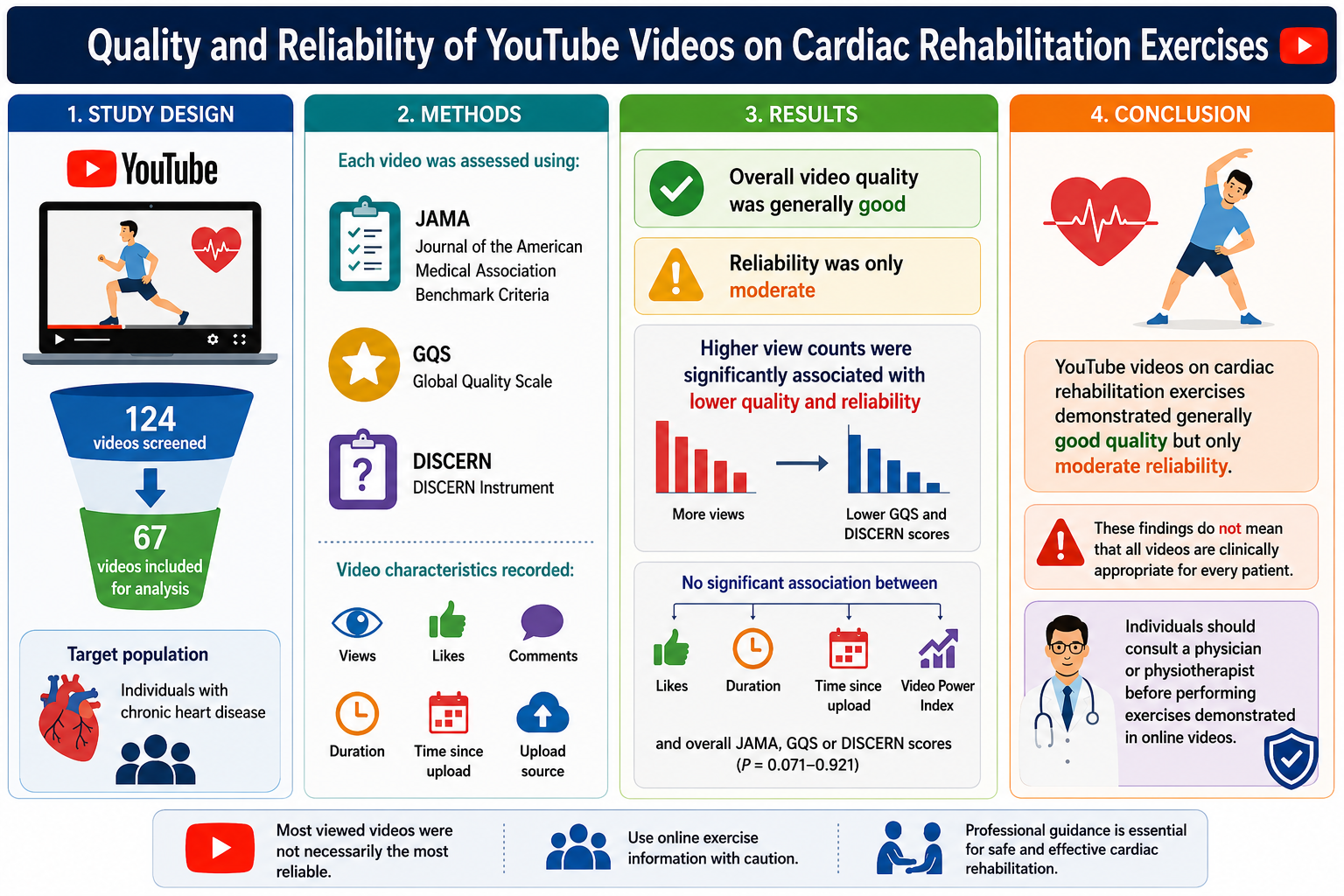
Background/Aim: YouTube is widely used by patients and caregivers seeking exercise-related health information; however, the scientific accuracy and clinical reliability of this content remain uncertain. This study aimed to evaluate the quality and reliability of YouTube videos on cardiac rehabilitation exercises for individuals with chronic heart disease.
Methods: A total of 124 YouTube videos were initially screened, and 67 videos that met the inclusion criteria were analyzed. Video characteristics, including duration, time since upload, views, likes, dislikes, comments, and upload source, were recorded. Each video was assessed using the Journal of the American Medical Association benchmark criteria, the Global Quality Scale, and the DISCERN score.
Results: The analyzed videos had a mean (SD) view count of 26,720.92 (68,307.01), comment count of 2.79 (7.68), like count of 149.74 (529.59), and dislike count of 0 (0). The total number of views was significantly correlated with the Global Quality Scale score (r = -0.368; P = 0.002) and the DISCERN score (r = -0.279; P = 0.022). Likes, time since upload, video power index, and video duration were not significantly correlated with overall DISCERN, Global Quality Scale, or Journal of the American Medical Association scores (P = 0.071-0.921).
Conclusion: YouTube videos on cardiac rehabilitation exercises demonstrated generally good quality but only moderate reliability. Nevertheless, these findings do not mean that all videos are clinically appropriate for every patient. Individuals should consult a physician or physiotherapist before performing exercises demonstrated in online videos.
Downloads
References
van Bakel B, Kroesen S, Bakker E, van Miltenburg R, Günal A, Scheepmaker A, et al. Effectiveness of an intervention to reduce sedentary behaviour as a personalised secondary prevention strategy for patients with coronary artery disease: main outcomes of the SIT LESS randomised clinical trial. Int J Behav Nutr Phys Act. 2023;20(1):17. doi: 10.1186/s12966-023-01419-z. DOI: https://doi.org/10.1186/s12966-023-01419-z
Michelsen HÖ, Henriksson P, Wallert J, Bäck M, Sjölin I, Schlyter M, et al. Organizational and patient-level predictors for attaining key risk factor targets in cardiac rehabilitation after myocardial infarction: The Perfect-CR study. Int J Cardiol. 2023;371:40-8. doi: 10.1016/j.ijcard.2022.09.012. DOI: https://doi.org/10.1016/j.ijcard.2022.09.012
Semerci R, Şimşek E, Savaş E, Orhan E, Erbey F. The quality and content analysis of YouTube videos about chemotherapy for children. Pediatr Blood Cancer. 2024;71(4):e30865. doi: 10.1002/pbc.30865. DOI: https://doi.org/10.1002/pbc.30865
YouTube Culture & Trends. Watching the pandemic. YouTube; 2022. Available from: https://www.youtube.com/trends/articles/covid-impact/. Accessed May 10, 2026.
Yoo M, Bang MH, Jang CW. Evaluation of YouTube videos as a source of information on pulmonary rehabilitation for COPD. Respir Care. 2022;67(5):534-42. doi: 10.4187/respcare.09651. DOI: https://doi.org/10.4187/respcare.09651
Balci AS, Cabuk KŞ, Topcu H, Efe AC, Ulas MG. Evaluation of the reliability, utility, and quality of the lid loading videos on YouTube. Int Ophthalmol. 2023;43(6):2065-72. doi: 10.1007/s10792-022-02606-w. DOI: https://doi.org/10.1007/s10792-022-02606-w
Gupta L. Assessment of quality and reliability of YouTube videos for patient and physician education on inflammatory myositis. Clin Rheumatol. 2023;42(5):1339-49. doi: 10.1007/s10067-023-06522-x. DOI: https://doi.org/10.1007/s10067-023-06522-x
Barabino E, Cittadini G. From search engines to large language models: a big leap for patient education! Cardiovasc Intervent Radiol. 2024;49:251-2. doi: 10.1007/s00270-024-03658-4. DOI: https://doi.org/10.1007/s00270-024-03658-4
Ayoub G, Chalhoub E, Sleilaty G, Kourie HR. YouTube as a source of information on breast cancer in the Arab world. Support Care Cancer. 2021;29:8009-17. doi: 10.1007/s00520-021-06403-6. DOI: https://doi.org/10.1007/s00520-021-06403-6
Lee H, Choi A, Jang Y, Lee JI. YouTube as a learning tool for four shoulder tests. Prim Health Care Res Dev. 2019;20:e70. doi: 10.1017/S1463423618000804. DOI: https://doi.org/10.1017/S1463423618000804
Smith PE, McGuire J, Falci M, Poudel DR, Kaufman R, Patterson MA, et al. Analysis of YouTube as a source of information for diabetic foot care. J Am Podiatr Med Assoc. 2019;109(2):122-6. doi: 10.7547/16-149. DOI: https://doi.org/10.7547/16-149
Tolu S, Yurdakul OV, Basaran B, Rezvani A. English-language videos on YouTube as a source of information on self-administer subcutaneous anti-tumour necrosis factor agent injections. Rheumatol Int. 2018;38(7):1285-92. doi: 10.1007/s00296-018-4047-8. DOI: https://doi.org/10.1007/s00296-018-4047-8
Oztermeli A, Karahan N. Evaluation of YouTube video content about developmental dysplasia of the hip. Cureus. 2020;12(8):e9557. doi: 10.7759/cureus.9557. DOI: https://doi.org/10.7759/cureus.9557
Silberg WM, Lundberg GD, Musacchio RA. Assessing, controlling, and assuring the quality of medical information on the Internet: caveant lector et viewor—let the reader and viewer beware. JAMA. 1997;277(15):1244-5. doi: 10.1001/jama.1997.03540390074039. DOI: https://doi.org/10.1001/jama.1997.03540390074039
Jildeh TR, Abbas MJ, Abbas L, Washington KJ, Okoroha KR. YouTube is a poor-quality source for patient information on rehabilitation and return to sports after hip arthroscopy. Arthrosc Sports Med Rehabil. 2021;3(4):e1055-63. doi: 10.1016/j.asmr.2021.03.011. DOI: https://doi.org/10.1016/j.asmr.2021.03.011
Onder ME, Zengin O. Quality of healthcare information on YouTube: psoriatic arthritis. Z Rheumatol. 2023;82(1):30-7. doi: 10.1007/s00393-021-01069-1. DOI: https://doi.org/10.1007/s00393-021-01069-1
Kim P, Eng TR, Deering MJ, Maxfield A. Published criteria for evaluating health related web sites. BMJ. 1999;318(7184):647-9. doi: 10.1136/bmj.318.7184.647. DOI: https://doi.org/10.1136/bmj.318.7184.647
Bernard A, Langille M, Hughes S, Rose C, Leddin D, Van Zanten SV. A systematic review of patient inflammatory bowel disease information resources on the World Wide Web. Am J Gastroenterol. 2007;102(9):2070-7. doi: 10.1111/j.1572-0241.2007.01325.x. DOI: https://doi.org/10.1111/j.1572-0241.2007.01325.x
Levent U, Surucu S. Are YouTube videos a sufficient resource for informing patients in the treatment of rotator cuff tears? J Health Sci Med. 2022;5(1):99-103. doi: 10.32322/jhsm.1010941. DOI: https://doi.org/10.32322/jhsm.1010941
Singh AG, Singh S, Singh PP. YouTube for information on rheumatoid arthritis—a wakeup call? J Rheumatol. 2012;39(5):899-903. doi: 10.3899/jrheum.111114. DOI: https://doi.org/10.3899/jrheum.111114
Zhang S, Fukunaga T, Oka S, Orita H, Kaji S, Yube Y, et al. Concerns of quality, utility, and reliability of laparoscopic gastrectomy for gastric cancer in public video sharing platform. Ann Transl Med. 2020;8(5):196. doi: 10.21037/atm.2020.01.78. DOI: https://doi.org/10.21037/atm.2020.01.78
Charnock D, Shepperd S, Needham G, Gann R. DISCERN: an instrument for judging the quality of written consumer health information on treatment choices. J Epidemiol Community Health. 1999;53(2):105-11. doi: 10.1136/jech.53.2.105. DOI: https://doi.org/10.1136/jech.53.2.105
Kocyigit BF, Nacitarhan V, Koca TT, Berk E. YouTube as a source of patient information for ankylosing spondylitis exercises. Clin Rheumatol. 2019;38:1747-51. doi: 10.1007/s10067-018-04413-0. DOI: https://doi.org/10.1007/s10067-018-04413-0
Rudd RE, Anderson JE, Oppenheimer S, Nath C. Health literacy: an update of medical and public health literature. In: Rudd RE, editor. Review of Adult Learning and Literacy: Connecting Research, Policy, and Practice. Vol 7. San Francisco (CA): Jossey-Bass; 2007. p. 175-204. DOI: https://doi.org/10.4324/9781003417996-6
Keelan J, Pavri-Garcia V, Tomlinson G, Wilson K. YouTube as a source of information on immunization: a content analysis. JAMA. 2007;298(21):2482-4. doi: 10.1001/jama.298.21.2482. DOI: https://doi.org/10.1001/jama.298.21.2482
Madathil KC, Rivera-Rodriguez AJ, Greenstein JS, Gramopadhye AK. Healthcare information on YouTube: a systematic review. Health Inform J. 2015;21(3):173-94. doi: 10.1177/1460458213512220. DOI: https://doi.org/10.1177/1460458213512220
Erdem MN, Karaca S. Evaluating the accuracy and quality of the information in kyphosis videos shared on YouTube. Spine. 2018;43(22):E1334-9. doi: 10.1097/BRS.0000000000002691. DOI: https://doi.org/10.1097/BRS.0000000000002691
Kunze KN, Cohn MR, Wakefield C, Hamati F, LaPrade RF, Forsythe B, et al. YouTube as a source of information about the posterior cruciate ligament: a content-quality and reliability analysis. Arthrosc Sports Med Rehabil. 2019;1(2):e109-14. doi: 10.1016/j.asmr.2019.09.003. DOI: https://doi.org/10.1016/j.asmr.2019.09.003
Staunton PF, Baker JF, Green J, Devitt A. Online curves: a quality analysis of scoliosis videos on YouTube. Spine. 2015;40(23):1857-61. doi: 10.1097/BRS.0000000000001137. DOI: https://doi.org/10.1097/BRS.0000000000001137
Mert A, Bozgeyik B. Quality and content analysis of carpal tunnel videos on YouTube. Indian J Orthop. 2022;56(1):73-8. doi: 10.1007/s43465-021-00430-5. DOI: https://doi.org/10.1007/s43465-021-00430-5
Sajadi KP, Goldman HB. Social networks lack useful content for incontinence. Urology. 2011;78(4):764-7. doi: 10.1016/j.urology.2011.04.074. DOI: https://doi.org/10.1016/j.urology.2011.04.074
Lee JS, Seo HS, Hong TH. YouTube as a source of patient information on gallstone disease. World J Gastroenterol. 2014;20(14):4066-70. doi: 10.3748/wjg.v20.i14.4066. DOI: https://doi.org/10.3748/wjg.v20.i14.4066
Zure M, Korkmaz MD, Menekşeoğlu AK. Exercises for fibromyalgia syndrome: what YouTube tells us as a source of information for patient and physician education. Clin Rheumatol. 2024;43(1):473-80. doi: 10.1007/s10067-023-06792-5. DOI: https://doi.org/10.1007/s10067-023-06792-5
Batar N, Aşkın G, İpek EB, Sevdin S, Özçalkap R. Assessment of the quality and reliability of information on nutrition for patients with diabetes on YouTube. Eur J Sci Technol. 2021;(31):268-74. doi: 10.31590/ejosat.992770. DOI: https://doi.org/10.31590/ejosat.992770
Downloads
- 277 538
Published
Issue
Section
How to Cite
License
Copyright (c) 2026 Elif Dilara Durmaz, Cansu Şahbaz Pirinççi, Muhammed Arca, Emine Ci̇han

This work is licensed under a Creative Commons Attribution-NonCommercial-NoDerivatives 4.0 International License.
Citations