Unmasking the psychiatric impact of ketamine in burn patients: Elevated risk of depression and acute stress reactions
Psychiatric impact of ketamine in burn patients
Authors
-
Davon Lee
Howard University College of Medicine
 https://orcid.org/0009-0002-9045-1341
-
Elizabeth Beyene
Howard University, Department of Internal Medicine
https://orcid.org/0000-0003-3472-013X
-
Da’Jhai Monroe
Howard University College of Medicine
https://orcid.org/0009-0006-0511-5984
-
Elijah McMillan
Howard University College of Medicine
https://orcid.org/0009-0006-2841-9323
-
Sierra Lyles
Howard University College of Medicine
https://orcid.org/0009-0009-1144-1497
-
Marqus Creavalle
Howard University College of Medicine
https://orcid.org/0009-0008-9219-6149
-
Biniam Zelelew
University of Global Health Equity
https://orcid.org/0000-0002-3899-2880
-
Syed Fahad Gillani
Howard University, Department of Internal Medicine
https://orcid.org/0009-0006-3936-3070
-
Mekdem Bisrat
Howard University, Department of Internal Medicine
https://orcid.org/0009-0006-2628-7259
-
Samrawit Zinabu
Howard University, Department of Internal Medicine
https://orcid.org/0009-0006-0211-5719
-
Miriam Michael
Howard University, Department of Internal Medicine
https://orcid.org/0000-0002-2478-4650

Keywords:
Ketamine, Burn Injury, Depression, Acute Stress ReactionAbstract
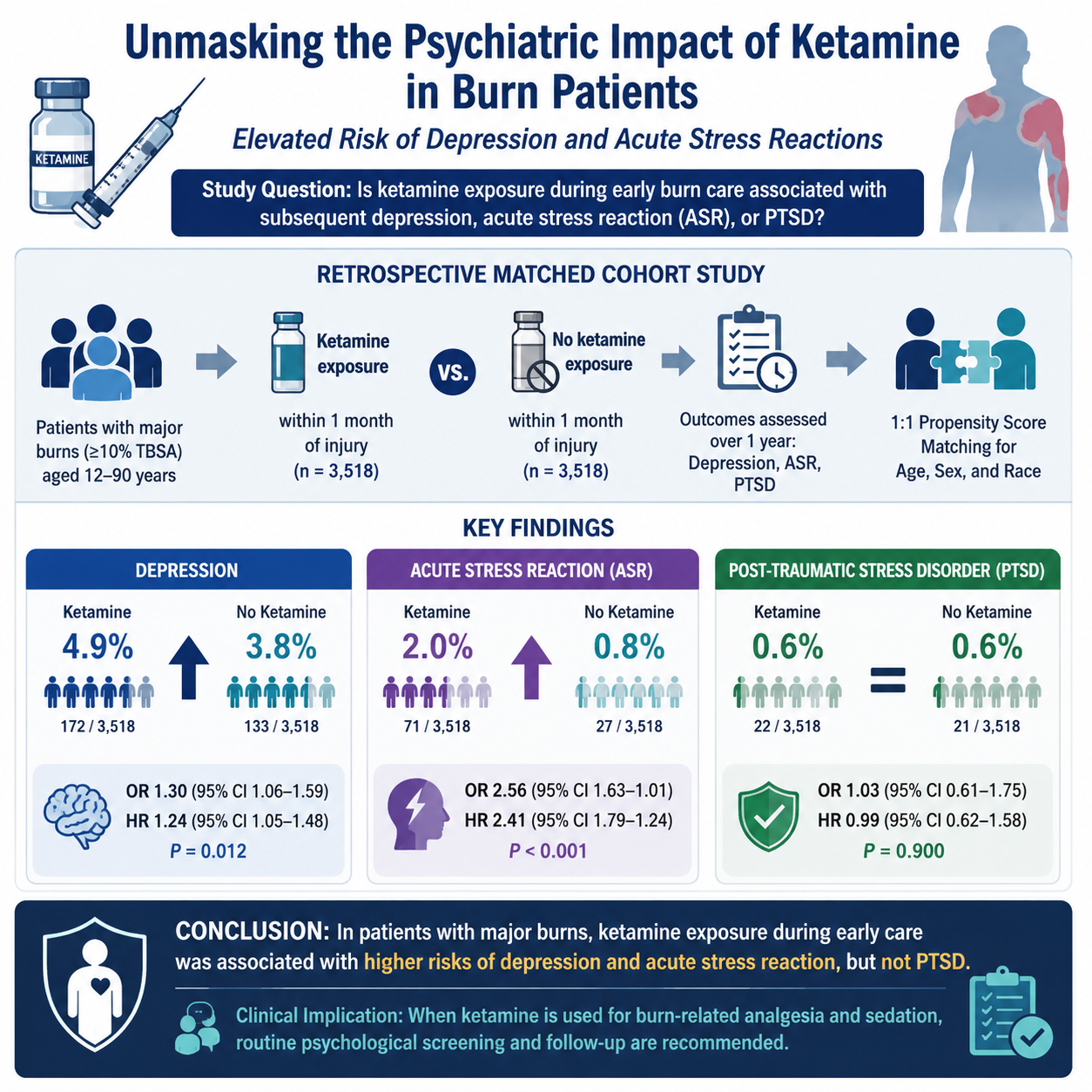
Background/Aim: Ketamine is frequently administered for analgesia and sedation during burn dressing changes, but its potential psychological impact remains a concern. This study assessed whether ketamine exposure during early burn care is associated with subsequent depression, acute stress reaction (ASR), or post-traumatic stress disorder (PTSD) in patients with major burns.
Methods: A retrospective cohort study was conducted using the TriNetX global health research network. Patients aged 12 to 90 years with burn injuries involving ≥10% total body surface area were included. Two cohorts were defined according to ketamine exposure within one month of injury. Propensity score matching (1:1) was performed for age, sex, and race, yielding 3,518 patients per group. Outcomes were evaluated over one year using diagnostic codes for depression, ASR, and PTSD. Analyses included risk estimates, odds ratios, Kaplan-Meier methods, and hazard ratios.
Results: Ketamine exposure was associated with a higher risk of depression (4.9% vs. 3.8%; odds ratio 1.30; hazard ratio 1.24; P = 0.012) and ASR (2.0% vs. 0.8%; odds ratio 2.56; hazard ratio 2.41; P < 0.001). PTSD incidence was similar between cohorts (0.6% vs. 0.6%; odds ratio 1.03; hazard ratio 0.99; P = 0.952).
Conclusion: In patients with major burns, ketamine exposure during early care was associated with increased risks of depression and ASR, but not PTSD. These findings support routine psychological screening and follow-up when ketamine is used for burn-related analgesia and sedation.
Downloads
References
Hirota K, Lambert DG. Ketamine: its mechanism(s) of action and unusual clinical uses. Br J Anaesth. 1996;77(4):441-4. DOI: https://doi.org/10.1093/bja/77.4.441
Anis NA, Berry SC, Burton NR, Lodge D. The dissociative anaesthetics ketamine and phencyclidine selectively reduce excitation of mammalian central neurones by N-methyl-aspartate. Br J Pharmacol. 1983;79(2):565-75. DOI: https://doi.org/10.1111/j.1476-5381.1983.tb11031.x
Green SM, Roback MG, Kennedy RM, Krauss B. Clinical practice guideline for emergency department ketamine dissociative sedation: 2011 update. Ann Emerg Med. 2011;57(5):449-61. DOI: https://doi.org/10.1016/j.annemergmed.2010.11.030
Kurdi MS, Theerth KA, Deva RS. Ketamine: current applications in anesthesia, pain, and critical care. Anesth Essays Res. 2014;8(3):283-90. DOI: https://doi.org/10.4103/0259-1162.143110
Fauerbach JA, Lawrence JW, Munster AM. Psychological distress following major burn injury. Psychosom Med. 1996;58(2):194-203.
Thombs BD, Bresnick MG, Magyar-Russell G. Depression in survivors of burn injury: a systematic review. Gen Hosp Psychiatry. 2006;28(6):494-502. DOI: https://doi.org/10.1016/j.genhosppsych.2006.08.010
Patterson DR, Everett JJ, Bombardier CH, Questad KA, Lee VK, Marvin JA. Psychiatric complications during acute burn rehabilitation. J Trauma. 1993;34(1):73-9.
Fauerbach JA, Heinberg LJ, Lawrence JW, Bryant AG, Richter L, Spence RJ. Coping with body image changes following a disfiguring burn injury. Health Psychol. 2002;21(2):115-21. DOI: https://doi.org/10.1037//0278-6133.21.2.115
Van Loey NE, Van Son MJ. Psychopathology and psychological problems in patients with burn scars: epidemiology and management. Am J Clin Dermatol. 2003;4(4):245-72. DOI: https://doi.org/10.2165/00128071-200304040-00004
Schönenberg M, Reichwald U, Domes G, Badke A, Hautzinger M. Ketamine aggravates symptoms of acute stress disorder in a naturalistic sample of accident victims. J Psychopharmacol. 2008;22(5):493-7. DOI: https://doi.org/10.1177/0269881107082481
Newcomer JW, Farber NB, Jevtovic-Todorovic V, Selke G, Melson AK, Hershey T, et al. Ketamine-induced NMDA receptor hypofunction as a model of memory impairment and psychosis. Neuropsychopharmacology. 1999;20(2):106-18. DOI: https://doi.org/10.1016/S0893-133X(98)00067-0
McGhee LL, Maani CV, Garza TH, Slater TM, Petz LN, Fowler M. The correlation between ketamine and post-traumatic stress disorder in burned service members. J Burn Care Res. 2008;29(6):S161.
Singh JB, Fedgchin M, Daly EJ, De Boer P, Cooper K, Lim P, et al. A double-blind, randomized, placebo-controlled, dose-frequency study of intravenous ketamine in patients with treatment-resistant depression. Am J Psychiatry. 2016;173(8):816-26. DOI: https://doi.org/10.1176/appi.ajp.2016.16010037
Li HY, Xu WJ, Wang YM, Xie S, Wang HL. Efficacy of perioperative esketamine on postoperative depression: a systematic review and meta-analysis. Front Psychiatry. 2025;16:1476449. DOI: https://doi.org/10.3389/fpsyt.2025.1476449
Murrough JW, Abdallah CG, Mathew SJ. Targeting glutamate signalling in depression: progress and prospects. Nat Rev Drug Discov. 2017;16(7):472-86. DOI: https://doi.org/10.1038/nrd.2017.16
Downloads
- 330 327
Published
Issue
Section
How to Cite
License
Copyright (c) 2026 Davon Lee, Elizabeth Beyene, Da’Jhai Monroe, Elijah McMillan, Sierra Lyles, Marqus Creavalle, Biniam Zelelew, Syed Fahad Gillani, Mekdem Bisrat, Samrawit Zinabu, Miriam Michael

This work is licensed under a Creative Commons Attribution-NonCommercial-NoDerivatives 4.0 International License.
Citations