A surgical bag retained for eight years: A case report
Surgical bag retained for eight years
Authors
-
Lidia Berthon
General Surgery, Noble's Hospital, Isle of Man
 https://orcid.org/0009-0003-6566-676X
-
Amir Rastegar
General Surgery, Noble's Hospital, Isle of Man
https://orcid.org/0009-0000-2472-8416
-
Nasibeh Khaleghnejad-tabari
General Surgery, Noble's Hospital, Isle of Man
https://orcid.org/0000-0003-4570-7416
-
Farshad Shabani
General Surgery, Noble's Hospital, Isle of Man
https://orcid.org/0009-0002-1117-9651
-
Andre Risha
General Surgery, Noble's Hospital, Isle of Man
https://orcid.org/0009-0009-9809-7325

Keywords:
retained surgical item, case report, surgical safety, small bowel obstruction, foreign bodyAbstract
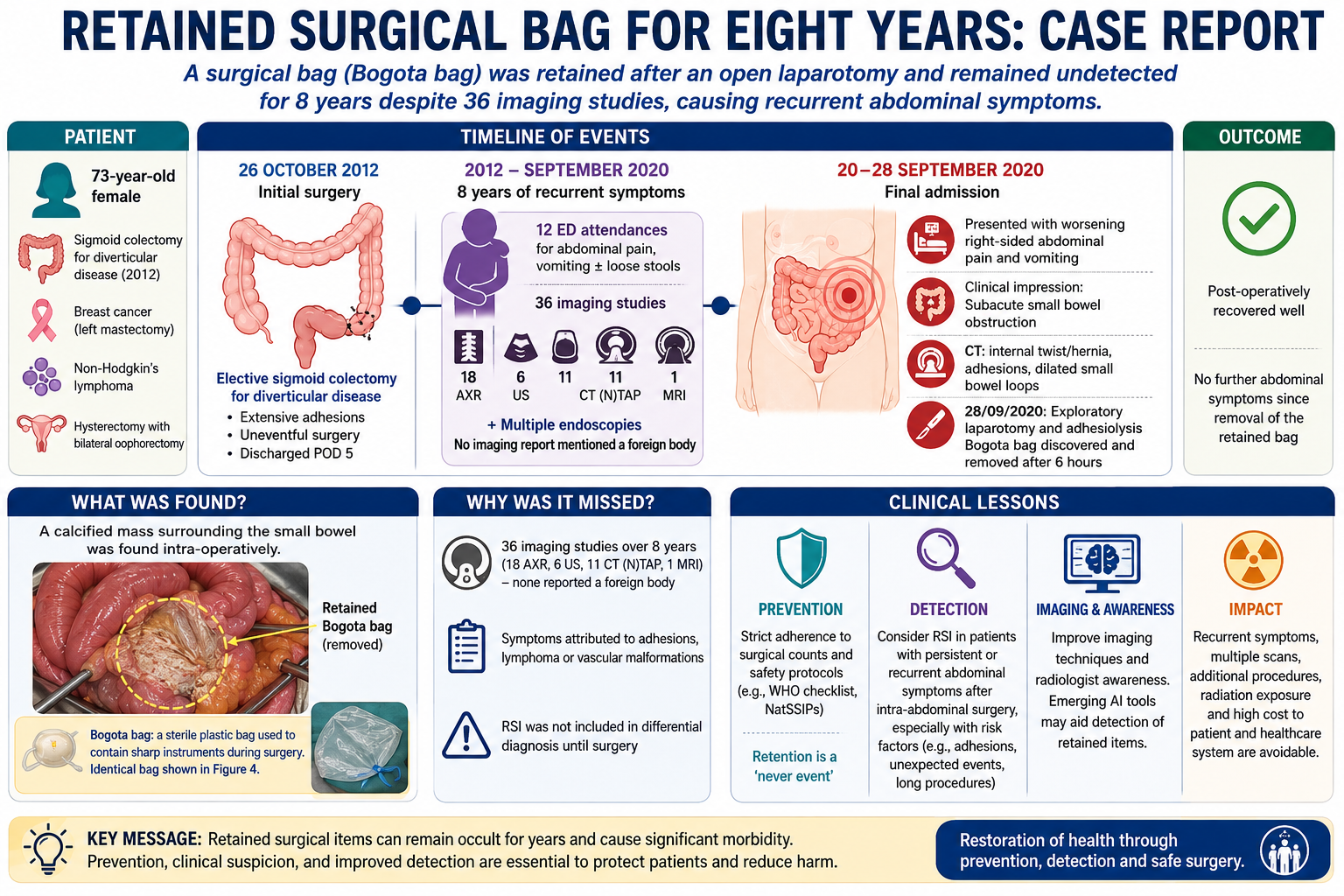
Retained surgical items, including sponges and other operative materials, can cause substantial harm beyond the perioperative period. We report the case of a 73-year-old woman in whom a surgical bag was retained for eight years after an open laparotomy performed in 2012. Abdominal pain and vomiting began two weeks after the original operation and continued intermittently throughout the eight-year period, leading to 36 imaging examinations. None of the reports raised concern for a retained surgical item. This case illustrates how retained surgical items may remain clinically occult despite recurrent symptoms and repeated imaging. It also highlights the importance of prevention, early suspicion, and inclusion of a retained surgical item in the differential diagnosis when postoperative abdominal symptoms persist, especially after technically complex surgery. The case is notable because the retained item was a large surgical bag and because of the prolonged interval before diagnosis.
Downloads
References
Gibbs V, Romano P. Retained surgical items: Definition and epidemiology. Patient Safety Network. 2024 Jan 4. Accessed February 3, 2025. Available from: https://psnet.ahrq.gov/primer/retained-surgical-items-definition-and-epidemiology
Hariharan D, Lobo DN. Retained surgical sponges, needles and instruments. Ann R Coll Surg Engl. 2013;95(2):87-92. doi: 10.1308/003588413X13511609957218. DOI: https://doi.org/10.1308/003588413X13511609957218
Wan W, Le T, Riskin L, Macario A. Improving safety in the operating room: a systematic literature review of retained surgical sponges. Curr Opin Anaesthesiol. 2009;22(2):207-14. doi: 10.1097/ACO.0b013e328324f82d. DOI: https://doi.org/10.1097/ACO.0b013e328324f82d
Health Services Safety Investigations Body. Retained swabs following invasive procedures: Investigation report. 2024 Apr 16. Accessed December 9, 2024. Available from: https://www.hssib.org.uk/patient-safety-investigations/retained-surgical-swabs/investigation-report/
Susmallian S, Raskin B, Barnea R. Surgical sponge forgotten for nine years in the abdomen: A case report. Int J Surg Case Rep. 2016;28:296-9. doi: 10.1016/j.ijscr.2016.10.026. DOI: https://doi.org/10.1016/j.ijscr.2016.10.026
Alsuhaimi MA, Alghamdi HS, Alshaiji SA, Fayi MA, Aldhafeeri SM. Retained surgical item (Gossypiboma): A case report and literature review. Ann Med Surg (Lond). 2023;85(7):3717-21. doi: 10.1097/MS9.0000000000000992. DOI: https://doi.org/10.1097/MS9.0000000000000992
Al-Qurayshi ZH, Hauch AT, Slakey DP, Kandil E. Retained foreign bodies: Risk and outcomes at the national level. J Am Coll Surg. 2015;220(4):749-59. doi: 10.1016/j.jamcollsurg.2014.12.015. DOI: https://doi.org/10.1016/j.jamcollsurg.2014.12.015
Williams TL, Tung DK, Steelman VM, Chang PK, Szekendi MK. Retained surgical sponges: Findings from incident reports and a cost-benefit analysis of radiofrequency technology. J Am Coll Surg. 2014;219(3):354-64. doi: 10.1016/j.jamcollsurg.2014.03.052. DOI: https://doi.org/10.1016/j.jamcollsurg.2014.03.052
Mettler FA Jr, Huda W, Yoshizumi TT, Mahesh M. Effective doses in radiology and diagnostic nuclear medicine: A catalog. Radiology. 2008;248(1):254-63. doi: 10.1148/radiol.2481071451. DOI: https://doi.org/10.1148/radiol.2481071451
Lin EC. Radiation risk from medical imaging. Mayo Clin Proc. 2010;85(12):1142-6. doi: 10.4065/mcp.2010.0260. DOI: https://doi.org/10.4065/mcp.2010.0260
Radiological Society of North America, American College of Radiology. Radiation dose from X-ray and CT exams. RadiologyInfo.org. Accessed December 9, 2024. Available from: https://www.radiologyinfo.org/en/info/safety-xray
Gawande AA, Studdert DM, Orav EJ, Brennan TA, Zinner MJ. Risk factors for retained instruments and sponges after surgery. N Engl J Med. 2003;348(3):229-35. doi: 10.1056/NEJMsa021721. DOI: https://doi.org/10.1056/NEJMsa021721
Centre for Perioperative Care. National Safety Standards for Invasive Procedures (NatSSIPs 2): Guidance on the prevention of retained foreign objects. 2023. Accessed December 9, 2024. Available from: https://cpoc.org.uk/guidelines-and-resources/guidelines/national-safety-standards-invasive-procedures-natssips
Manzella A, Borba-Filho P, Albuquerque E, Farias F, Kaercher J. Imaging of gossypibomas: Pictorial review. AJR Am J Roentgenol. 2009;193(6 Suppl):S94-101. doi: 10.2214/AJR.07.7132. DOI: https://doi.org/10.2214/AJR.07.7132
Kawakubo M, Waki H, Shirasaka T, Kojima T, Mikayama R, Hamasaki H, et al. A deep learning model based on fusion images of chest radiography and X-ray sponge images supports human visual characteristics of retained surgical items detection. Int J Comput Assist Radiol Surg. 2023;18(8):1459-67. doi: 10.1007/s11548-022-02816-8. DOI: https://doi.org/10.1007/s11548-022-02816-8
Stawicki SPA, Moffatt-Bruce SD, Ahmed HM, Anderson HL 3rd, Balija TM, Bernescu I, et al. Retained surgical items: A problem yet to be solved. J Am Coll Surg. 2013;216(1):15-22. doi: 10.1016/j.jamcollsurg.2012.08.026. DOI: https://doi.org/10.1016/j.jamcollsurg.2012.08.026
Downloads
- 374 382
Published
Issue
Section
How to Cite
License
Copyright (c) 2026 Lidia Berthon, Amir Rastegar, Nasibeh Khaleghnejad-tabari, Farshad Shabani, Andre Risha

This work is licensed under a Creative Commons Attribution-NonCommercial-NoDerivatives 4.0 International License.
Citations