Evaluation of healthcare professionals’ acceptance of digital intraoperative hemodynamic data recording using the technology acceptance model
Digital intraoperative hemodynamic recording and technology acceptance model
Authors
-
Merve Yusi̇fov
Beyhekim Training and Research Hospital, Department of Anesthesiology and Reanimation, Selçuklu, Konya, Turkey
 https://orcid.org/0000-0003-2560-3855
-
Resul Yılmaz
Necmettin Erbakan University, Faculty of Medicine, Department of Anesthesiology and Reanimation, Selçuklu, Konya, Turkey
https://orcid.org/0000-0002-5527-2893

Keywords:
Digital Health, Intraoperative Monitoring, Technology Acceptance Model, Hemodynamic Data., anesthesiaAbstract
Background/Aim: This study aimed to evaluate a software prototype developed for the digitalization of intraoperative hemodynamic data recording and to examine healthcare professionals’ acceptance of this system within the framework of the Technology Acceptance Model.
Methods: This single-center, cross-sectional, descriptive study was conducted in the operating room of a university hospital between January 1, 2025, and December 31, 2025. A total of 75 healthcare professionals actively involved in intraoperative patient monitoring were included. Data were collected using a Participant Information Form and the 28-item Technology Acceptance Model Scale. Statistical analyses included descriptive statistics, independent samples t-test, one-way analysis of variance, Pearson correlation analysis, and multiple linear regression analysis.
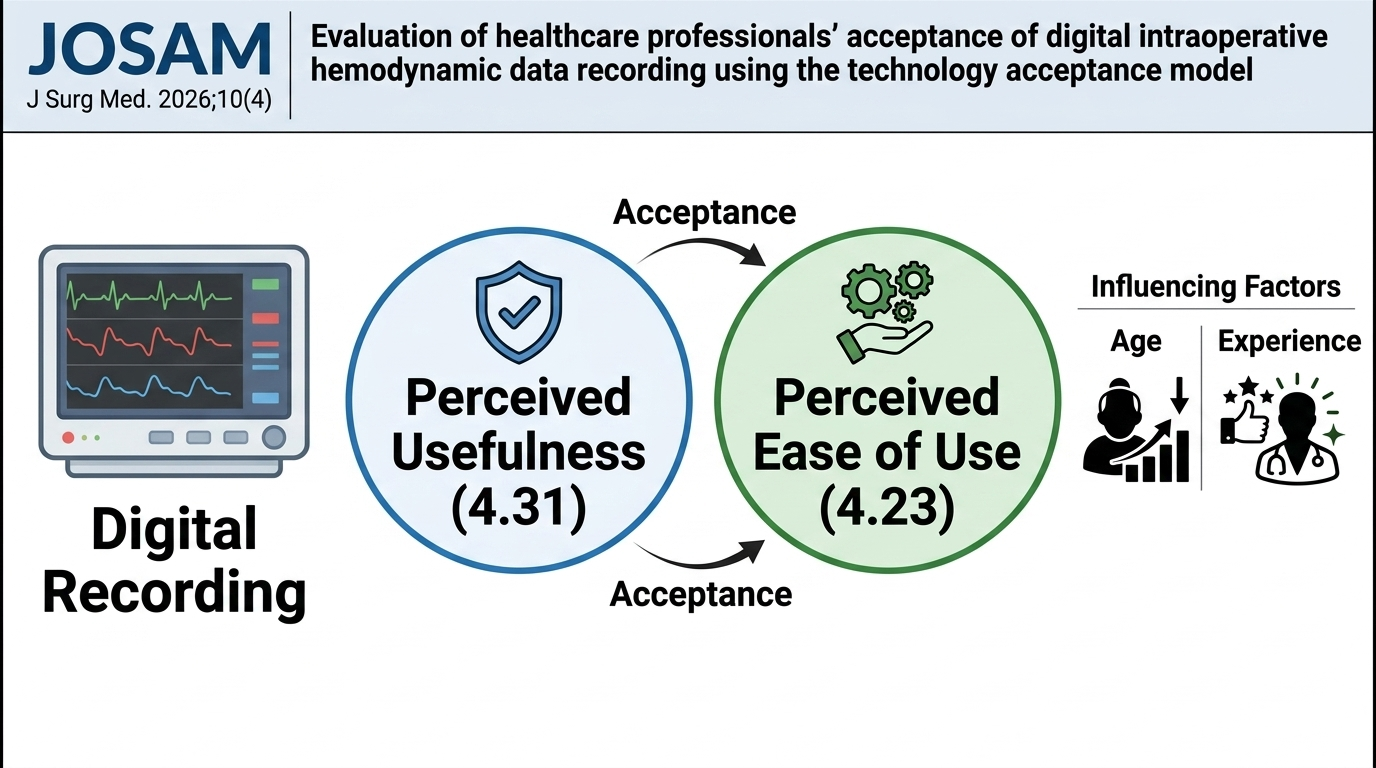
Results: Participants had high perceived usefulness and perceived ease of use scores, with mean (SD) values of 4.31 (0.56) and 4.23 (0.60), respectively. Age was negatively and significantly correlated with perceived usefulness (r=-0.348, P=0.002), indicating that perceived usefulness decreased with increasing age. Professional experience significantly differed according to perceived ease of use (P=0.042). No significant relationship was found between perceived ease of use and perceived usefulness (r=0.030, P=0.797). Multiple linear regression analysis showed that age was an independent significant predictor of perceived usefulness (β=-0.025, 95% CI: -0.040 to -0.009, P=0.002).
Conclusion: Digital intraoperative hemodynamic data recording was highly accepted by healthcare professionals. The finding that age was associated with technology acceptance suggests that generational differences should be considered during digital transformation. Automated recording systems may reduce workload and improve patient safety; however, organizational support and adequate technical infrastructure are critical for widespread implementation.
Downloads
References
Simpao AF, Rehman MA. Anesthesia information management systems. Anesth Analg. 2018;127(1):90-4. doi: 10.1213/ANE.0000000000002545. DOI: https://doi.org/10.1213/ANE.0000000000002545
Williams DC, Warren RW, Ebeling M, Andrews AL, Teufel RJ 2nd. Physician use of electronic health records: Survey study assessing factors associated with provider-reported satisfaction and perceived patient impact. JMIR Med Inform. 2019;7(2):e10949. doi: 10.2196/10949. DOI: https://doi.org/10.2196/10949
Murphy DR, Meyer AND, Russo E, Sittig DF, Wei L, Singh H. The burden of inbox notifications in commercial electronic health records. JAMA Intern Med. 2016;176(4):559-60. doi: 10.1001/jamainternmed.2016.0209. DOI: https://doi.org/10.1001/jamainternmed.2016.0209
Palaniswamy SR, Jain V, Chakrabarti D, Bharadwaj S, Sriganesh K. Completeness of manual data recording in the anaesthesia information management system: A retrospective audit of 1000 neurosurgical cases. Indian J Anaesth. 2019;63(10):797-804. doi: 10.4103/ija.IJA_450_19. DOI: https://doi.org/10.4103/ija.IJA_450_19
Davis FD. Perceived usefulness, perceived ease of use, and user acceptance of information technology. MIS Q. 1989;13(3):319-40. doi: 10.2307/249008. DOI: https://doi.org/10.2307/249008
Venkatesh V, Morris MG, Davis GB, Davis FD. User acceptance of information technology: Toward a unified view. MIS Q. 2003;27(3):425-78. doi: 10.2307/30036540. DOI: https://doi.org/10.2307/30036540
Park JH, Lee CW, Do C. Examining users’ acceptance intention of health applications based on the Technology Acceptance Model. Healthcare (Basel). 2025;13(6):596. doi: 10.3390/healthcare13060596. DOI: https://doi.org/10.3390/healthcare13060596
Çakmak AF, Benk S, Budak T. The acceptance of tax office automation system (VEDOP) by employees: Factorial validation of Turkish adapted Technology Acceptance Model (TAM). Int J Econ Finance. 2011;3(6):107-16. doi: 10.5539/ijef.v3n6p107. DOI: https://doi.org/10.5539/ijef.v3n6p107
Kruse CS, Karem P, Shifflett K, Vegi L, Ravi K, Brooks M. Evaluating barriers to adopting telemedicine worldwide: A systematic review. J Telemed Telecare. 2018;24(1):4-12. doi: 10.1177/1357633X16674087. DOI: https://doi.org/10.1177/1357633X16674087
Thanthrige A, Lu B, Sako Z, Wickramasinghe N. Determinants of health care technology adoption using an integrated Unified Theory of Acceptance and Use of Technology and Task Technology Fit Model: Systematic review and meta-analysis. J Med Internet Res. 2025;27:e64524. doi: 10.2196/64524. DOI: https://doi.org/10.2196/64524
Downloads
- 289 443
Published
Issue
Section
How to Cite
License
Copyright (c) 2026 Merve Yusi̇fov, Resul Yılmaz

This work is licensed under a Creative Commons Attribution-NonCommercial-NoDerivatives 4.0 International License.
Citations