Did the COVID-19 pandemic have an impact on pregnant women's participation in routine antenatal care and on pregnancy and neonatal outcomes?
Impact of COVID-19 on antenatal care and pregnancy outcomes
Authors
-
Murat Gözüküçük
University of Health Sciences, Ankara Training and Education Hospital, Department of Obstetrics and Gynecology, Ankara, Turkey
 https://orcid.org/0000-0002-4418-7570
-
Özge Saygılı Irhan
University of Health Sciences, Ankara Training and Education Hospital, Department of Obstetrics and Gynecology, Ankara, Turkey
https://orcid.org/0000-0002-6866-2305
-
Sena Münire Kaya Kaya
University of Health Sciences, Ankara Training and Education Hospital, Department of Obstetrics and Gynecology, Ankara, Turkey
https://orcid.org/0000-0002-7213-5022
-
Süheyla Aydoğmuş
University of Health Sciences, Ankara Training and Education Hospital, Department of Obstetrics and Gynecology, Ankara, Turkey
https://orcid.org/0000-0003-3441-4597
-
Yusuf Üstün
University of Health Sciences, Ankara Training and Education Hospital, Department of Obstetrics and Gynecology, Ankara, Turkey
https://orcid.org/0000-0003-1529-2555

Keywords:
Antenatal care, COVID-19, PandemicAbstract
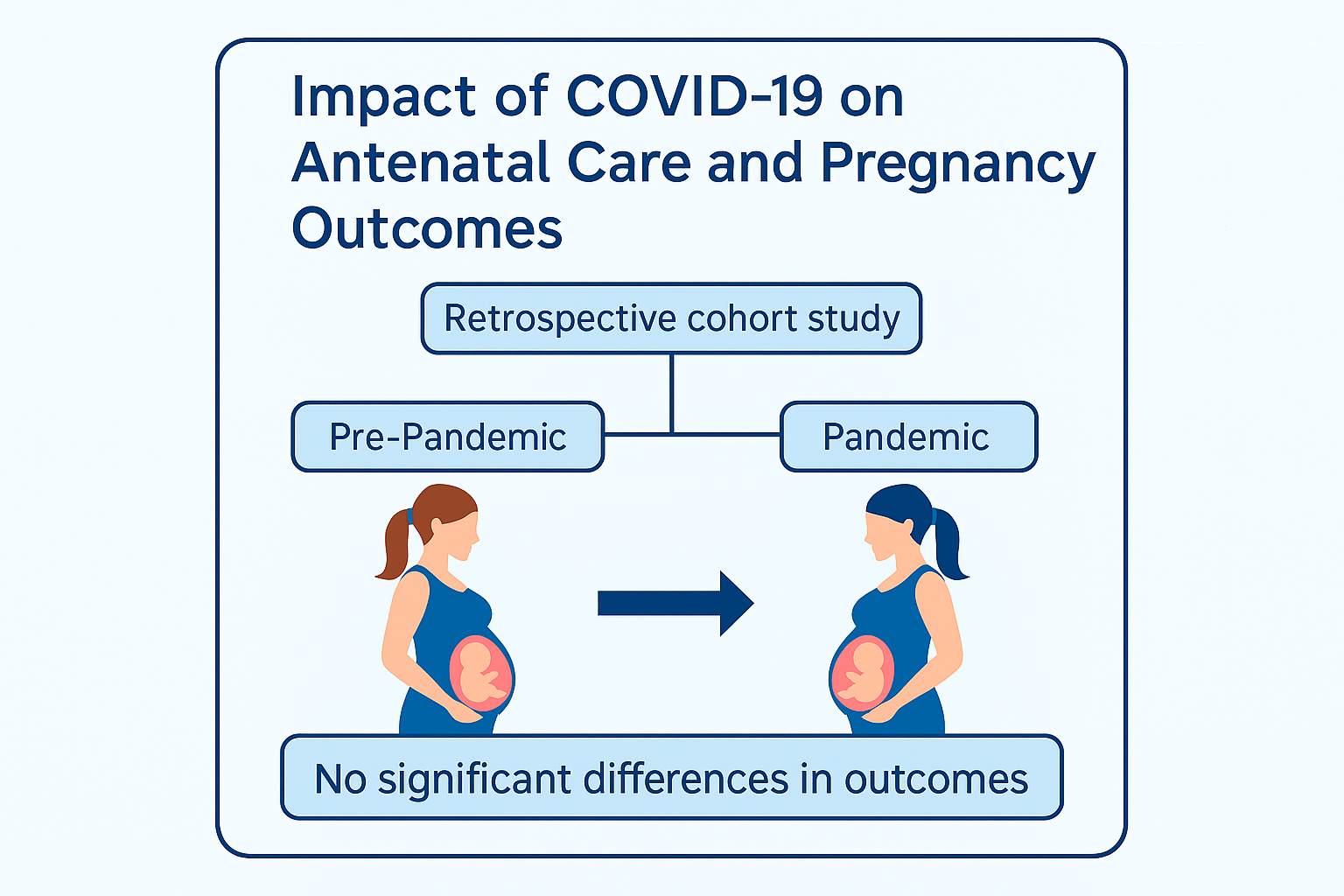
Background/Aim: The COVID-19 pandemic disrupted healthcare systems, affecting pregnant women's access to routine antenatal care. Changes in health policies and heightened anxiety may have influenced care utilization and outcomes. This study aimed to assess the pandemic's impact on antenatal attendance and compare pregnancy and neonatal outcomes with the pre-pandemic period in a tertiary center.
Methods: We retrospectively included all women who delivered at Ankara Training and Research Hospital between September 2020 and January 2021 (pandemic period) and those who delivered between September 2019 and January 2020 (pre-pandemic control). Pregnancies with any documented SARS-CoV-2 infection were excluded. Demographics, number of antenatal visits, antenatal screening tests, obstetric complications, and perinatal outcomes were compared.
Results: A total of 532 women delivered during the pandemic and 650 before the pandemic. The cesarean section rate was higher during the pandemic (40.4% vs 33.8%; P=0.020), with a higher primary cesarean rate (18.4% vs 11.2%; P<0.001). Antenatal visit categories were <4, 4–10, and >10 visits for pandemic vs pre-pandemic groups as follows: 39.4% vs 38.5%, 36.8% vs 42.1%, and 23.8% vs 19.4%, respectively (overall comparison P=0.087). While not statistically significant, there was a trend toward fewer women having 4–10 visits and more having >10 visits during the pandemic. Antenatal screening tests (Down syndrome screening, gestational diabetes screening, and second-trimester anomaly screening) were performed more frequently during the pandemic (all P<0.05). The mean gestational age at delivery was higher during the pandemic (39.25 (1.42) vs 38.65 (2.84) weeks; P<0.001), with fewer preterm (<37 weeks) births and more post-term (>41 weeks) births (P=0.012). Other neonatal outcomes were comparable, except for a small but statistically significant difference in 1-minute Apgar scores (9.02 (0.71) vs 9.10 (1.19); P=0.001).
Conclusion: During the pandemic, overall antenatal attendance did not differ significantly from the pre-pandemic period, although screening tests were utilized more frequently and cesarean delivery was more common. Despite these changes, pregnancy and neonatal outcomes were largely similar between periods.
Downloads
References
Saadat S, Rawtani D, Hussain CM. Environmental perspective of COVID-19. Sci Total Environ. 2020;728:138870. DOI: https://doi.org/10.1016/j.scitotenv.2020.138870
Wang C, Pan R, Wan X, Tan Y, Xu L, Ho CS, et al. Immediate psychological responses and associated factors during the initial stage of the COVID-19 epidemic among the general population in China. Int J Environ Res Public Health. 2020;17(5):1729. DOI: https://doi.org/10.3390/ijerph17051729
Editorial. The impact of the coronavirus (COVID-19) pandemic on maternity care in Europe. Midwifery. 2020;88:102779. DOI: https://doi.org/10.1016/j.midw.2020.102779
Lebel C, MacKinnon A, Bagshawe M, Tomfohr-Madsen L, Giesbrecht G. Elevated depression and anxiety symptoms among pregnant individuals during the COVID-19 pandemic. J Affect Disord. 2020;277:5–13. DOI: https://doi.org/10.1016/j.jad.2020.07.126
Cullen W, Gulati G, Kelly BD. Mental health in the COVID-19 pandemic. QJM. 2020;113(5):311–6. DOI: https://doi.org/10.1093/qjmed/hcaa110
da Silva AG, Miranda DM, Diaz AP, Teles AS, Malloy-Diniz F, Palha AP. Mental health: why it still matters in the midst of a pandemic. Braz J Psychiatry. 2020;42(3):229–31. DOI: https://doi.org/10.1590/1516-4446-2020-0009
Corbett GA, Milne SJ, Hehir MP, Lindow SW, O’Connell MP. Maternal mental health in the time of the COVID-19 pandemic. Eur J Obstet Gynecol Reprod Biol. 2020;249:96–7. DOI: https://doi.org/10.1016/j.ejogrb.2020.04.022
Beeckman K, Louckx F, Putman K. Determinants of the number of antenatal visits in a metropolitan region. BMC Public Health. 2010;10:527. DOI: https://doi.org/10.1186/1471-2458-10-527
Alexander GR, Kotelchuck M. Assessing the role and effectiveness of prenatal care: history, challenges, and directions for future research. Public Health Rep. 2001;116:306–16. DOI: https://doi.org/10.1016/S0033-3549(04)50052-3
World Health Organization. Provision of effective antenatal care. Geneva: WHO; 2006.
Raatikainen K, Heiskanen N, Heinonen S. Under-attending free antenatal care is associated with adverse pregnancy outcomes. BMC Public Health. 2007;7:268. DOI: https://doi.org/10.1186/1471-2458-7-268
American Academy of Pediatrics; American College of Obstetricians and Gynecologists. Antepartum care. In: Guidelines for Perinatal Care. Washington (DC): ACOG; 2007. p. 83–137.
Bhowmik KR, Das S, Islam A. Modelling the number of antenatal care visits in Bangladesh to determine risk factors for reduced attendance. PLoS One. 2020;15(1):e0228215. DOI: https://doi.org/10.1371/journal.pone.0228215
Shiferaw K, Mengiste B, Gobena T, Dheresa M. The effect of antenatal care on perinatal outcomes in Ethiopia: a systematic review and meta-analysis. PLoS One. 2021;16(1):e0245003. DOI: https://doi.org/10.1371/journal.pone.0245003
Stacey T, Thompson JM, Mitchell EA, Zuccollo JM, Ekeroma AJ, McCowan LM. Antenatal care, identification of suboptimal fetal growth and risk of late stillbirth: findings from the Auckland Stillbirth Study. Aust N Z J Obstet Gynaecol. 2012;52(3):242–7. DOI: https://doi.org/10.1111/j.1479-828X.2011.01406.x
Gumede S, Black V, Naidoo N, Chersich MF. Attendance at antenatal clinics in inner-city Johannesburg and associations with birth outcomes: analysis of birth register data from three facilities. BMC Public Health. 2017;17:443. DOI: https://doi.org/10.1186/s12889-017-4347-z
Heaman MI, Martens PJ, Brownell MD, Chartier MJ, Derksen SA, Helewa ME. Association of inadequate and intensive prenatal care with maternal, fetal, and infant outcomes: a population-based study in Manitoba, Canada. J Obstet Gynaecol Can. 2019;41(7):947–59. DOI: https://doi.org/10.1016/j.jogc.2018.09.006
Worku AG, Yalew AW, Afework MF. Contributions of maternity care to reducing adverse pregnancy outcomes: a cohort study in Dabat District, Northwest Ethiopia. Matern Child Health J. 2014;18(6):1336–44. DOI: https://doi.org/10.1007/s10995-013-1367-x
Van Dijk JAW, Anderko L, Stetzer F. Impact of prenatal care coordination on birth outcomes. J Obstet Gynecol Neonatal Nurs. 2011;40(1):98–108. DOI: https://doi.org/10.1111/j.1552-6909.2010.01206.x
Rosário EVN, Gomes MC, Brito M, Costa D. Determinants of maternal health care and birth outcome in the Dande Health and Demographic Surveillance System area, Angola. PLoS One. 2019;14(8):e0221280. DOI: https://doi.org/10.1371/journal.pone.0221280
Blondel B, Dutilh P, Delour M, Uzan S. Poor antenatal care and pregnancy outcome. Eur J Obstet Gynecol Reprod Biol. 1993;50(3):191–6. DOI: https://doi.org/10.1016/0028-2243(93)90200-V
World Health Organization. Integrated management of pregnancy and childbirth: standards for maternal and neonatal care. Geneva: WHO; 2007.
Downloads
- 325 420
Published
Issue
Section
How to Cite
License
Copyright (c) 2026 Murat Gözüküçük, Özge Saygılı Irhan, Sena Münire Kaya Kaya, Süheyla Aydoğmuş, Yusuf Üstün

This work is licensed under a Creative Commons Attribution-NonCommercial-NoDerivatives 4.0 International License.
Citations